South Dakota Landowner Permission Requirements
Getting permission to ride on private land in South Dakota is about more than asking someone nearby. You need the right person’s approval, a clear understanding of where you may go, and a plan for any roads or public land along the way. Here’s how to make those boundaries clear before your ATV or UTV leaves the trailer.
What landowner permission does and does not cover
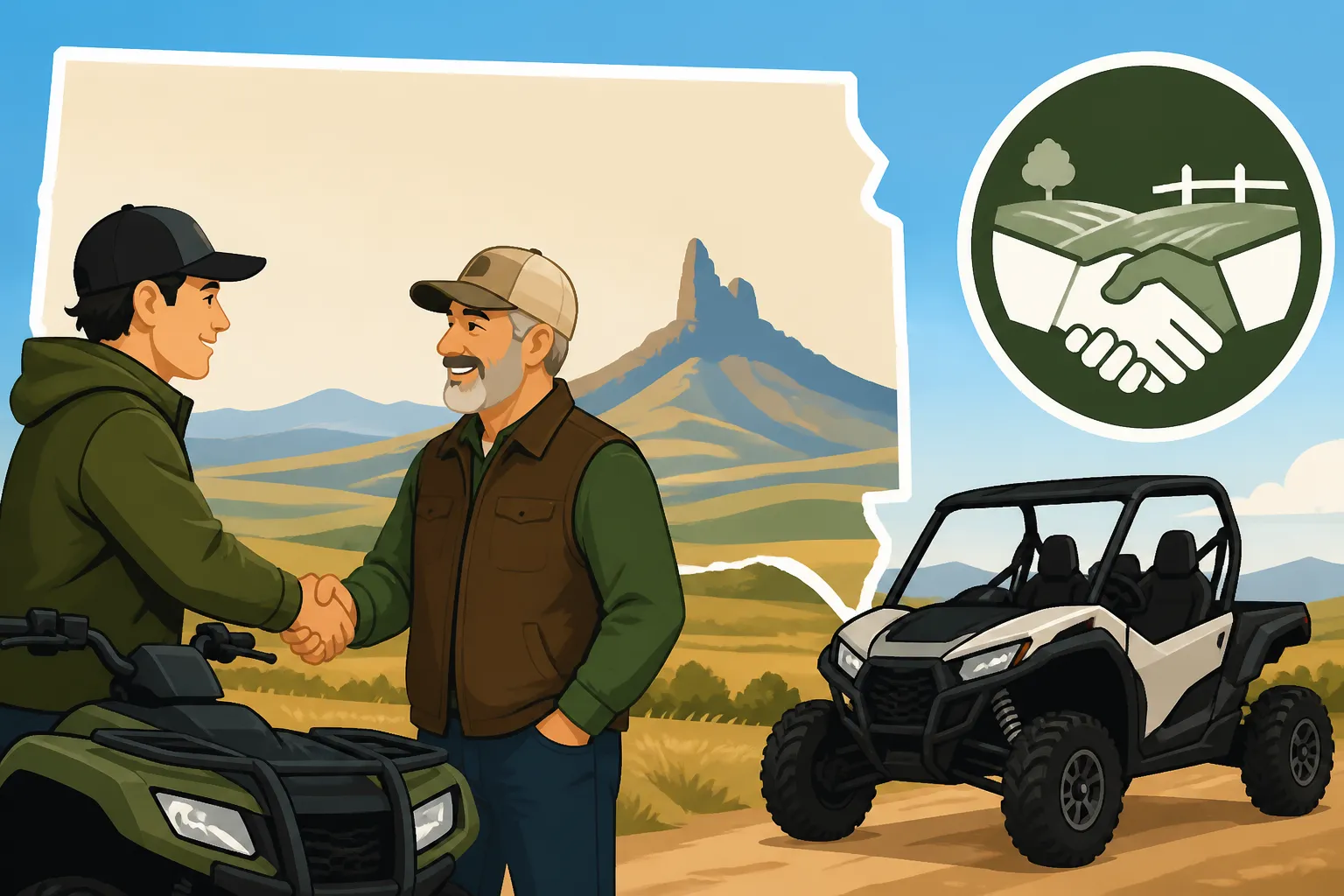
If you plan to ride on private property, get permission from the person who owns or controls the land before entering. Do not assume that a track, open gate, tire marks, or another rider’s presence means you have permission. A landowner may allow access to one person, one route, or one type of activity without opening the property to everyone.
Permission is specific to the land and the activity described. Approval to ride on one parcel does not automatically let you cross a neighboring parcel, use a public road, camp, hunt, or bring other riders. Nor does a friendly conversation necessarily make the limits clear when plans change or someone else in your group arrives later.
For the broader rules that apply to private ground, see South Dakota Rules for Riding Private Property and South Dakota Landowner Permission Rules. The practical starting point is simple: identify the person with authority over the parcel and ask about the exact activity you have in mind.
Find the person with authority
The record owner may not be the only person who manages access. A tenant, ranch manager, caretaker, or leaseholder may handle day-to-day decisions, but their authority to allow recreational riding can vary. If you are unsure, ask whether the person can authorize ATV or UTV use, or request confirmation from the owner or manager.
This matters especially on working ranches and leased land. A person who has permission to graze livestock or manage a field may not have authority to invite recreational riders. Do not treat a lease, a neighborly relationship, or a landowner’s earlier approval for another purpose as permission to ride. For the separate issues involved with leased ground, see [South Dakota Rules for Riding a Grazing Lease].
Permission does not erase other rules
Private-land permission is not a universal pass. It does not allow you to ride on an adjoining parcel, bypass a road restriction, or ignore safety and equipment requirements that apply to the kind of riding you are doing. It also does not grant access to public land. If your route includes a public riding area, check that area’s access rules and permit requirements separately.
Likewise, permission from a landowner does not make every route suitable for every machine. A narrow trail, soft field, steep bank, or bridge may be inappropriate for a wide or heavy UTV. Ask about limits before riding rather than assuming that access means every part of the property is open.
A useful way to separate the questions is:
| Question | What to confirm |
|---|---|
| May I enter the property? | Permission from the owner or someone authorized to grant access |
| Where may I ride? | Parcel boundaries, approved routes, and any closed areas |
| Who may come? | Approved riders, passengers, and additional machines |
| What may we do? | Riding only, or other activities such as parking or camping |
| Does the route cross public land? | Separate access rules, permits, and closures |
| Are there operating limits? | Hours, speed, noise, gates, livestock, and weather conditions |
If the route touches federal land, do not assume private permission carries across the boundary. Review South Dakota Rules for Riding Federal Land before planning that part of the ride.
How to ask and make the limits clear
A good permission request is specific, brief, and easy to answer. Explain who is riding, what kind of machine you will use, when you plan to visit, and which route or area you want to use. If the landowner wants to know whether you will be traveling alone, towing a trailer, or bringing passengers, answer directly.
Avoid asking only, “Can we ride here sometime?” That leaves key details unresolved. Instead, ask about a particular date or time window and describe the proposed route. If you do not know the property boundaries, say so and ask the landowner to identify them before you start.
Written confirmation is a practical safeguard
A written message is useful even when access begins with an in-person conversation. Text or email can help both sides remember the date, approved area, and conditions. Written permission is not a substitute for checking current rules, and its legal effect can depend on the circumstances, but a clear record can prevent misunderstandings.
Include the following details when practical:
- The name of the person granting permission and the property or parcel covered.
- The names of the riders, or the size of the group.
- The dates or time period when access is allowed.
- The machines permitted, such as ATVs, UTVs, or both.
- The route or area you may use and any areas that are off-limits.
- Whether passengers, guests, parking, or staging are allowed.
- Any instructions about gates, livestock, crops, speed, noise, or fire.
- A way to contact the landowner if conditions or plans change.
Keep the confirmation accessible during the ride, but do not treat it as proof that every person who sees it can enter every part of the property. Permission may be limited or withdrawn. If the landowner sets a new boundary or asks you to leave, respect that instruction and stop riding there.
Ask about gates, livestock, and changing conditions
Ranch and farm access comes with responsibilities that may not be obvious to a visitor. Ask whether gates should be left open or closed, and follow the instruction each time you pass through. Do not rely on a gate’s position as a guide; it may have been left open temporarily for work or livestock movement.
Stay away from livestock unless the landowner specifically directs you otherwise. Keep machines controlled, avoid sudden noise or close approaches, and slow down near animals, people, buildings, equipment, and working areas. If livestock are being moved or a field is in use, take the route the landowner approves or postpone the ride.
Conditions can change. Rain may make a trail fragile, a landowner may need to move equipment, or a route may be closed for planting, harvest, or other work. A previous “yes” should not be treated as permanent permission for future visits. Ask again when the date, group, route, or activity changes.
Private land, public routes, and permits
A common planning mistake is treating a route as one continuous area when it crosses parcels with different owners or rules. A landowner can authorize riding on their property, but not on the next parcel, a county right-of-way, or a public riding area. Check each transition before the ride.
Mark the planned route on a map and identify property boundaries, roads, trailheads, and any public land it reaches. If the boundary is uncertain, ask the landowner to clarify it; do not use a fence, trail, or visible track as a definitive property line. A map is useful for planning, but it does not replace permission.
Public land requires its own access check
Some public riding areas have designated routes, operating periods, permit rules, or closures. These requirements are separate from a private landowner’s approval. Before riding onto a state or federal area, confirm what kind of machine is allowed, which routes are open, and whether the machine needs a permit or other authorization.
For state trail access, start with South Dakota’s Motorized Trail Permit and check the specific riding area’s current rules. A permit for a public trail does not give you permission to cross private land to reach it. In the other direction, private permission does not replace a public-land permit when one is required.
Rules can also differ depending on whether the machine is plated and where it is being operated. For example, do not assume a plate for road use replaces a trail permit. Review Why South Dakota Honors Only a Plated Machine if you are sorting out how out-of-state registration may apply, and confirm current requirements for the route you intend to ride.
Road crossings and connecting routes
Permission to ride a ranch trail does not automatically authorize use of a public road to connect two pieces of private land. Before planning a crossing or short road segment, check the rules for that road and the machine. A landowner’s approval only covers the land or access they control; it cannot waive requirements set for public roads or other jurisdictions.
If a route requires you to travel along a road, shoulder, ditch, or right-of-way, verify that the specific use is allowed. If it is not, choose another route rather than improvising at the property boundary. The same caution applies to a public trailhead: permission to park on private land nearby does not mean you may ride from that parking spot across land you have not been authorized to enter.
Before you unload: a practical permission checklist
A short check before the ride can prevent a costly disagreement and protect the landowner’s property. Confirm the permission with the person who granted it, especially if the visit is not on the same day as the original conversation. Then make sure every rider understands the route and restrictions.
Use this checklist:
- Confirm the person granting access. Make sure they own or manage the land, or have authority to allow recreational riding.
- Describe the group and machines. Tell them how many people and vehicles are coming, including passengers and guests.
- Confirm the date and time. Do not assume permission for one visit covers repeat trips.
- Agree on the route. Identify the entry point, approved riding area, turnarounds, and off-limits areas.
- Clarify boundaries. Ask what to do where the route approaches neighboring land, a road, or public property.
- Ask about working conditions. Check for livestock, equipment, crops, gates, or activities that may affect access.
- Follow restrictions. Respect limits on speed, noise, hours, parking, fires, and group size.
- Check separate rules. Confirm road-use, trail, and public-land requirements for every part of the route.
- Keep the confirmation available. Carry a written message or other record, and save the landowner’s contact information.
- Stop if the situation changes. If access is unclear, a route is blocked, or the landowner changes the instructions, do not push ahead.
If permission is denied, treat the answer as final. Do not return through another entrance, follow someone else’s tracks, or assume a past invitation still applies. If you are already on the property and learn that access was not authorized, leave by a reasonable route and contact the person responsible rather than continuing the ride.
Permission is also not a guarantee against damage or injury. Stay within your ability and the machine’s limits, avoid fragile ground, and tell the landowner promptly if a fence, gate, crop, or other property is damaged. Agreeing in advance on how to report an issue is often easier than trying to resolve it after the ride.
Planning across multiple parcels takes a little more work, but it is safer than guessing. For broader access guidance, see Private Ground Access for South Dakota Riders. A clear request, written confirmation, and route check help keep private access separate from public-road and trail requirements.
Disclaimer
This article is for general informational purposes only and does not constitute professional advice. Laws, prices and regulations vary by location and change over time. Consult a qualified professional for guidance on your specific situation.