South Dakota Rules for Riding a Grazing Lease
A grazing lease is not a blanket invitation to ride. In South Dakota, ATV and UTV access depends on who owns or manages the land, what authority the leaseholder has, and whether your route crosses public roads or designated trails. The safest approach is to identify the land first, get clear permission, then check the rules for every part of your route.
The short answer: permission depends on who controls the land
A grazing lease gives someone permission to graze livestock under particular terms. It does not automatically give other riders permission to drive across the property, and it may not give the leaseholder authority to grant that permission either.
Before unloading, work out who controls the ground you want to ride. That might be a private landowner, a rancher leasing private pasture, or a public agency that has leased grazing rights. Each situation calls for a different permission check.
| Land situation | Who to contact first | What to verify |
|---|---|---|
| Private pasture leased for grazing | The landowner and the grazing leaseholder | Whether either person can authorize riding, and which areas and dates are allowed |
| Public land with a grazing lease | The agency managing the land, and the permittee if relevant | Whether motorized recreation is allowed on the specific route |
| A road or trail crossing leased pasture | The land manager or road authority, plus the person controlling adjoining land where needed | Whether the route is legally open and whether a vehicle permit is required |
| A ranch road used by agreement | The person who controls access to the road | Whether the agreement covers motorized recreation, not just livestock or work access |
For private property, start with the landowner and ask whether the lease gives the rancher authority to approve recreational vehicle use. The rancher may be the right person to ask, but it is better not to assume that. A lease can limit access, reserve it to the owner, or assign specific responsibilities to the tenant.
For public land, a grazing permit or lease is not the same as ownership. The permittee may have rights related to livestock and ranch operations without having authority to open agency-managed land to recreational riding. Check with the agency responsible for that parcel and ask about the exact route, not just the general area.
A useful rule of thumb is to get permission from the person or agency that controls both the land and the activity you want to do. The broader points in South Dakota Landowner Permission Requirements and South Dakota Rules for Riding Private Property apply here too.
Identify the lease before planning a route
The phrase “grazing lease” can describe different arrangements. The name alone does not tell you whether riding is allowed, who can approve it, or what public-land rules apply.
Private land leased for livestock
A rancher may lease pasture from a private owner. The rancher may control day-to-day use of the pasture, but the written agreement might reserve recreational access to the owner or prohibit motorized use. A rancher’s permission is valuable, but when the authority is unclear, ask whether the owner also needs to approve.
Be specific about the machine and the purpose. Permission for a ranch employee to use a UTV for livestock work may not cover a visitor taking a recreational ride. Likewise, permission to reach a cabin or check a fence does not necessarily authorize a longer loop across the lease.
If the landowner and leaseholder give different answers, do not treat the more permissive answer as enough. Ask them to confirm the arrangement together, or choose another route.
Public land leased for grazing
Public land may be used for grazing under an agreement with a government agency. The grazing permittee’s use rights do not necessarily include permission to authorize recreational ATV or UTV travel. The public agency may allow some motorized travel, restrict it to designated routes, close an area seasonally, or require a permit.
Ask the agency which routes are open to your type of vehicle and whether the grazing arrangement affects access. Do not rely on a fence line, two-track, or visible tire marks as proof that a route is open. For agency-managed land, South Dakota Rules for Riding Federal Land and [South Dakota Rules for Riding a State Trail] can help explain why route status matters, but confirm the rules for the actual parcel.
A road crossing leased land
A route may look like a public road while crossing grazing land, or it may be a private ranch road that resembles a public route. Those are not interchangeable. A road’s existence does not by itself establish that recreational ATV or UTV use is allowed.
Check who maintains or controls the road and whether it is open to the public. If the route is private, get permission from whoever has authority over it. If it is a public route, confirm any vehicle, equipment, permit, or seasonal requirements that apply. A legal route can still be subject to restrictions that do not apply to ordinary ranch work.
When your route uses a ranch road, South Dakota Rules for Riding a Ranch Road is a useful related topic. For a route crossing several parcels, verify each segment rather than assuming one person’s permission covers the entire trip.
Get clear permission and define what it covers
A quick conversation can prevent a serious misunderstanding. Permission should be specific enough that both sides understand where you may ride and what conduct is allowed. Written permission is especially helpful when the ride involves guests, a group, a rental machine, or access across multiple parcels.
Ask about:
- The exact parcel, road, trail, or gate you may use.
- Whether permission covers an ATV, UTV, or both.
- The dates and times access is allowed.
- Whether passengers or other riders are included.
- Where you may park, unload, and turn around.
- Whether riding is limited to a particular route or task.
- Any closed areas, livestock concerns, or seasonal restrictions.
- Whether the permission can be withdrawn if conditions change.
A text or email can record the basic agreement, but it does not replace any required agency authorization or permit. Keep the message available while riding, and make sure every person in the group understands the limits.
It can help to ask direct questions rather than relying on a vague “you can ride the place.” For example: “May we ride these two marked ranch roads on Saturday with two ATVs, and can we use the connecting route to reach the public trailhead?” That gives the landholder a chance to identify a boundary, closed gate, or route that is not included.
Do not treat permission for one purpose as permission for another. Access to check livestock, repair a fence, or reach a hunting location may not cover recreational riding. Permission to cross a property also does not necessarily allow stopping, camping, target practice, or driving off the agreed route.
For a private ranch, the practical questions in Who You Ask Before Riding a Grazing Lease and Written Permission From a South Dakota Ranch Owner are worth considering before you load up.
Check permits, route rules, and conditions before you ride
Permission answers who has allowed you onto the land. It does not automatically answer whether your machine may use every road or trail in the area, or whether a separate permit is required.
Separate land access from vehicle requirements
A permission letter is not a road registration, a trail permit, or an agency approval. Depending on where you ride, you may need to meet separate requirements for the machine and the route. A plate that allows certain road use does not necessarily substitute for a trail permit, and a trail permit does not grant access across private land.
If the grazing route connects with a designated motorized trail, check the rules for that trail and the permit required for it. If you ride on a public road, check the road-use requirements that apply to your machine. If you are visiting from outside South Dakota, also check whether your home-state registration is recognized for the specific use and whether a South Dakota permit applies. The state’s general reciprocity information is covered in Does South Dakota Honor Out-of-State Registration?.
A grazing lease does not create an exception from a permit requirement. Conversely, a permit does not grant permission to cross a lease. These are separate questions, so confirm both before riding. For ranch-only access, see When Ranch-Only Riding Needs No Trail Permit, and check the precise route rather than assuming that all land near a public trail is treated the same way.
Confirm that the route is open
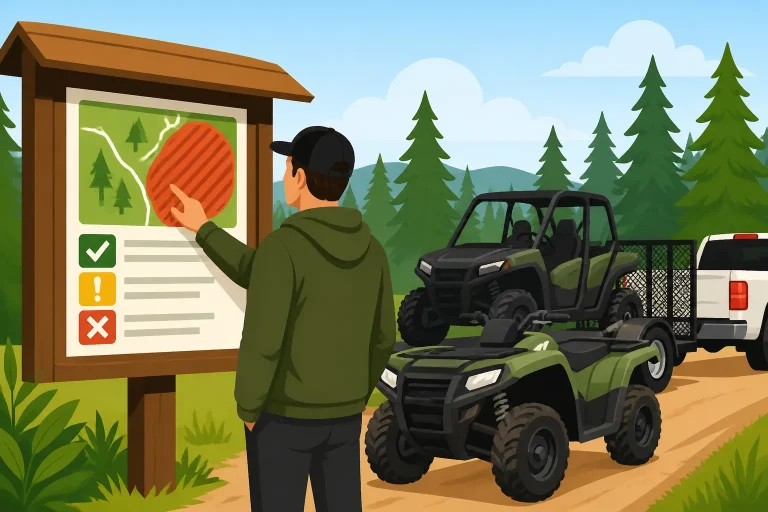
A route that was open last season may be closed now. Agency closures, fire conditions, weather, maintenance, livestock operations, or a change in access agreement can affect where you may ride. Check current notices from the land manager and ask the landholder about temporary restrictions.
Stay on the approved route. Do not use a grazing lease as a reason to cut across pasture, follow an unmarked two-track, or bypass a gate. If a route is blocked, stop and ask before detouring. A detour can take you onto a different parcel or into an area where motorized travel is prohibited.
For agency-managed routes, check official maps and closure notices before setting out. South Dakota Trail Closures to Check First offers a useful reminder to verify conditions close to your trip, rather than relying only on an old map or a route someone remembers.
Protect livestock, gates, and working operations
A grazing operation is a working environment. Riders can interfere with livestock movement, damage fencing, or create hazards for people doing ranch work. Keep speed low around animals, give them room, and stop if livestock are crowded against a fence or moving through a gate. Do not chase animals or ride through a herd to stay on schedule.
Leave gates as you find them unless the landholder has told you otherwise. A gate may be open to allow livestock through, or closed to keep animals in a pasture. Ask about gate instructions before the ride and follow them consistently. If a gate is locked or marked closed, do not force it or go around it.
Keep to the surface and route you were authorized to use. Avoid wet or soft ground where tires can cut ruts, and do not create a new track through grass or across a hillside. Report a downed fence, damaged gate, injured animal, or other problem to the landholder promptly.
A practical pre-ride sequence
- Identify the parcel and determine whether it is private, state-managed, federal, or otherwise controlled.
- Ask the landowner, leaseholder, or public agency who has authority to approve the ride.
- Confirm the exact route, dates, machine types, and any limits on guests or stops.
- Check road, trail, registration, and permit requirements separately.
- Review current closures and ask about livestock, gates, and active ranch work.
- Keep permission and any required permit information accessible during the ride.
- Stay on the approved route and turn back if the conditions or instructions are unclear.
If you cannot confirm who controls access, do not assume that a grazing lease makes the area open to recreational riding. Choosing a route with clear authorization is a safer alternative to settling a land-access question at a gate or roadside.
Disclaimer
This article is for general informational purposes only and does not constitute professional advice. Laws, prices and regulations vary by location and change over time. Consult a qualified professional for guidance on your specific situation.