South Dakota Rules for Riding a Bridge
Riding your ATV or UTV in South Dakota can be an incredible experience, but knowing where you can and cannot go is absolutely critical to staying safe and legal. One common point of confusion for many riders, especially those new to the state or just looking to explore, revolves around bridges. It's not always clear if that small bridge crossing a creek on a gravel road, or even a larger bridge over a river, is fair game for your off-road machine. This guide will clarify South Dakota's rules for riding a bridge, helping you understand the regulations, navigate safely, and avoid any unwanted trouble.
Understanding South Dakota's Bridge Rules for ATVs and UTVs
When you're out on your ATV or UTV, the sight of a bridge can bring up questions: Is this considered part of the road? Is it off-limits like a highway? South Dakota's regulations for riding off-road vehicles on public roads and rights-of-way can be quite nuanced, and bridges often fall into a grey area for riders who aren't familiar with the specifics. Generally speaking, if you are legally riding on a road or in a ditch where ATVs and UTVs are permitted, then crossing a bridge that is an integral part of that pathway is usually allowed. However, this isn't a blanket permission for all bridges, and there are critical distinctions to understand.
The "Legal Ditch" Connection
Many riders in South Dakota take advantage of the state's generous ditch riding rules. For those unfamiliar, [South Dakota's Ditch Riding Rule] generally permits ATVs and UTVs to operate in the bottom of a highway ditch or on the back-slope of the ditch, unless specifically prohibited by a county. When you're following these rules and your path naturally leads you to a bridge that spans a culvert, a small creek, or even a county-maintained waterway, that bridge is typically considered an extension of the legal right-of-way you're already using.
Think of it this way: if you're legally riding in the ditch alongside a county road and you come to a small bridge designed to allow that road and ditch to cross a natural obstacle, you are generally expected to continue your lawful travel over that bridge. The bridge isn't a separate, forbidden zone; it's simply part of the infrastructure supporting the path you're allowed to be on. This applies predominantly to secondary roads, county roads, and unpaved section lines where ATV and UTV use is often more prevalent and permitted.
Bridges as Extensions of Permitted Travel
The core principle here is that if your ATV or UTV is legally allowed on the specific type of road or right-of-way leading up to the bridge, then the bridge itself is usually included in that permission. This means that if you're riding a gravel road where ATVs are permitted, you can cross any bridge that is part of that gravel road. The state's intent is not to create arbitrary roadblocks in otherwise permissible travel routes. The bridge serves as a necessary component to maintain the flow of traffic, whether that traffic includes your UTV or a pickup truck.
However, this "extension of permitted travel" doesn't magically grant you access to roads or bridges you're otherwise prohibited from using. For example, if your machine isn't street legal and you encounter a bridge on a paved state highway where ATVs are generally banned, that bridge doesn't become a legal crossing point just because it's a bridge. It maintains the same restrictions as the road it's part of. Understanding [Are ATVs Street Legal in South Dakota?] and [South Dakota Street Legal ATV Requirements] is crucial for distinguishing between where your machine is generally permitted and where it isn't, which then dictates your bridge crossing privileges.
Specific Scenarios and Limitations for Bridge Riding
While the general rule of "if the road is legal, the bridge is too" holds true for many situations, South Dakota has specific limitations that riders absolutely need to be aware of. Not all bridges are created equal in the eyes of the law, and blindly assuming you can cross any bridge can lead to serious fines or, worse, dangerous situations.
Crossing State and Federal Highways
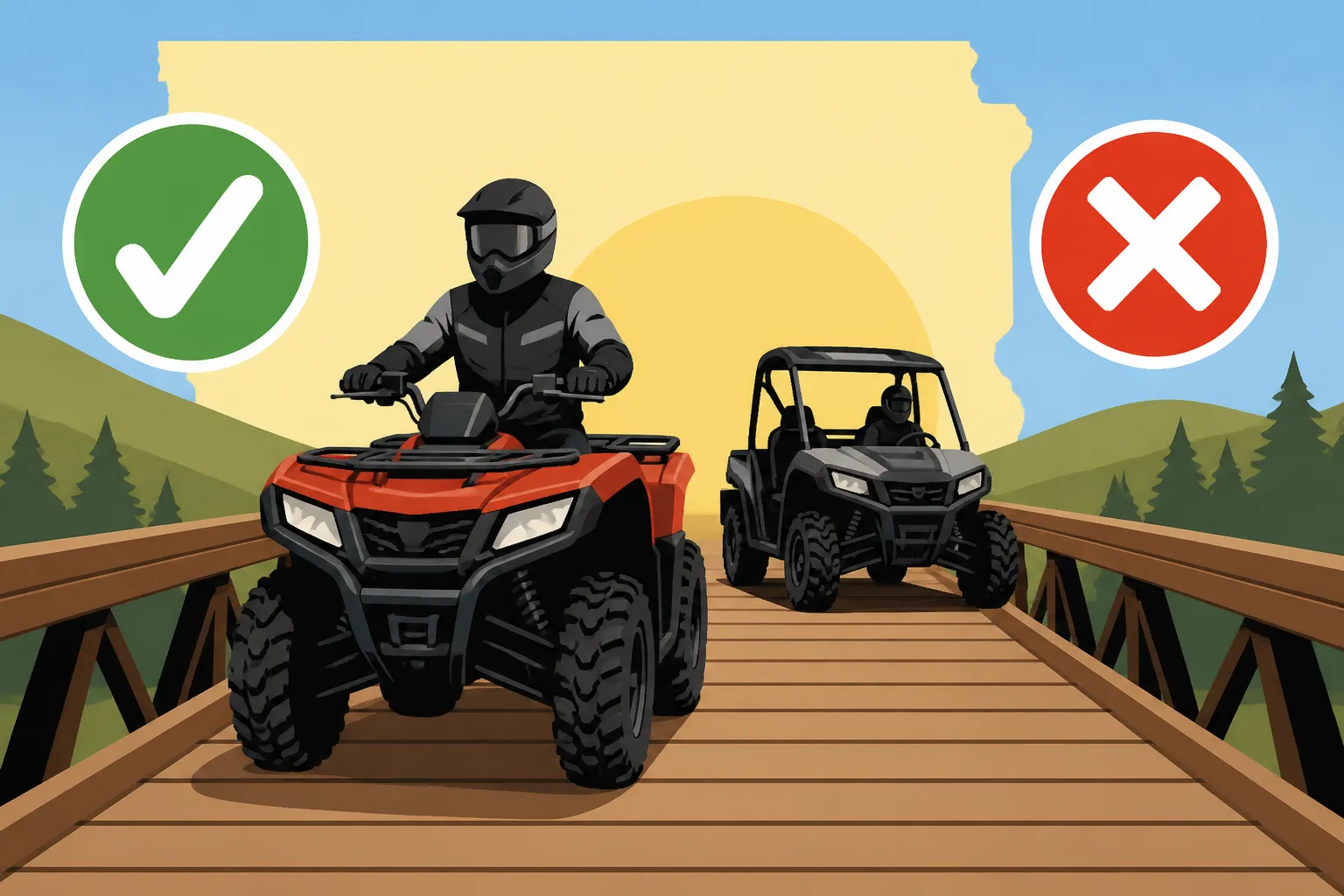
This is perhaps the most critical distinction: you generally cannot ride your ATV or UTV on state or federal highways, and by extension, you cannot ride over bridges that are part of these major roadways. These are high-speed, high-traffic arteries not designed for off-road vehicle use. Even if you're riding in a legal ditch alongside a state highway, attempting to cross a major bridge that carries the highway over a river or a deep canyon is typically illegal and extremely hazardous. The rules governing [South Dakota Rules for Crossing a Highway] are strict and are primarily designed to keep ATVs and UTVs off high-speed roadways.
There's a fundamental difference between crossing a small culvert bridge on a county road and attempting to navigate a multi-lane bridge on an interstate or state route. The latter poses a severe risk to both the ATV rider and other motorists. Law enforcement actively patrols these areas, and citations for illegal highway use are common. Even if you believe you can quickly dart across, the risks far outweigh any perceived convenience.
Local Road and Section Line Bridges
On the flip side, bridges found on local, county-maintained roads, gravel roads, and section lines are typically fair game, provided your machine is otherwise permitted on those pathways. Many of these rural bridges are modest structures, sometimes just concrete culverts with gravel fill, designed to maintain continuous travel on lesser-used routes. If you're riding [South Dakota Rules for Riding a Gravel Road] or exploring [South Dakota Rules for Riding a Section Line], you will encounter these types of bridges frequently.
These are the places where most ATV and UTV bridge crossings will legitimately occur. However, always pay attention to posted signage. While rare, a specific county or local authority could prohibit ATV/UTV use on a particular bridge, perhaps due to structural concerns or local ordinances. Always err on the side of caution and look for signs that might restrict your travel.
Weight Limits and Bridge Integrity
Beyond legal permissions, there's a practical consideration, particularly for heavier UTVs and larger side-by-sides: bridge weight limits. While most modern bridges on public roads are built to withstand heavy vehicle traffic, some older, smaller, or privately maintained bridges might have posted weight restrictions. For the vast majority of ATVs and UTVs, this won't be an issue on publicly maintained roads, as even a large UTV typically weighs far less than a standard passenger vehicle.
However, if you're on extremely rural, unmaintained, or private property, you might encounter bridges or culverts that are not designed for the weight of your machine, especially if you're hauling gear or have multiple passengers. It's always wise to exercise judgment. If a bridge looks dilapidated, has missing planks, or appears unstable, it's best to find an alternative route, regardless of the legal right-of-way. Safety should always be your top priority, even on durable machines that can handle a lot, like those outfitted with heavy-duty components from SuperATV.
Navigating Bridge Crossings Safely and Legally
Crossing bridges on your ATV or UTV isn't just about knowing the law; it's also about practicing safe riding habits. Even on bridges where you're legally allowed to operate, certain precautions can prevent accidents and ensure a smooth, enjoyable ride.
Signage and Local Ordinances
Before approaching any bridge, especially in an unfamiliar area, always keep an eye out for regulatory signs. While many rural areas might lack extensive signage, any posted restrictions, whether for specific vehicles or weight limits, are legally binding. A sign indicating "No Off-Road Vehicles" or "ATVs Prohibited" on a particular bridge, even if the road leading to it seems permissible, must be obeyed. [What a South Dakota Trooper Checks Roadside] often includes adherence to such signage.
Local ordinances can sometimes add an extra layer of complexity. While state law generally dictates what's allowed on certain road types, a specific county or municipality might have stricter rules for certain areas within its jurisdiction. It's always a good idea, if you plan extended riding in a particular county, to quickly check their website for any local ATV/UTV ordinances. This is especially true if you are planning on riding in or near smaller towns.
Equipment for Road-Legal Crossings
If you plan on riding on any public roads or crossing public bridges, even if they are gravel roads or section lines, your machine needs to be equipped to be road-legal in South Dakota. This means more than just having an engine. For instance, [South Dakota Lighting Requirements for ATVs] include having functional headlights and brake lights, especially if you might be riding near dusk or at night. A functional horn is also a requirement under [South Dakota Horn Requirement] for street-legal machines, which helps alert other vehicles or pedestrians to your presence, particularly important when visibility might be limited on a bridge.
| Required Equipment for Road Use (South Dakota) | Purpose | Notes |
|---|---|---|
| Headlights | Visibility for rider and to other traffic | Must be on when operating from sunset to sunrise, or during times of limited visibility. |
| Taillights/Brake Lights | Visibility from rear, signaling braking | Essential for safety, especially on shared bridges. |
| Horn | Alerting others | Crucial for warning pedestrians, cyclists, or other vehicles on shared pathways. |
| Rearview Mirror | Situational awareness behind machine | Required for road-legal operation, helps with awareness before and after crossing. |
| Spark Arrester | Fire prevention | Critical for any off-road machine, especially in dry conditions. |
| Muffler | Noise reduction | Required to meet sound regulations. |
| Eye Protection | Rider safety | Required for all riders; often goggles or a face shield. |
| Driver's License | Legal operation of a motor vehicle | Required for street-legal operation on roads and bridges. |
| License Plate (if applicable) | Identification, proof of registration | Essential for compliance on roads. |
| Trail Permit (if on motorized trails) | Access to designated trails | While not for roads, critical if bridge connects to a trail system. [South Dakota Trail Permits Explained] |
Ensuring your machine meets the [South Dakota Equipment List for Road Use] helps you blend seamlessly with other traffic, minimizes safety risks, and demonstrates your commitment to responsible riding. Investing in quality components, like a durable windshield or robust lighting from SuperATV, can further enhance your safety and compliance.
Exercising Caution and Awareness
Even when a bridge is legally permissible, always approach it with caution. Reduce your speed, especially if the surface changes (e.g., from gravel to pavement, or metal grates). Bridges can sometimes be slick from moisture, ice, or even just wet leaves. Be extra vigilant for other traffic, including cars, trucks, cyclists, pedestrians, and even horseback riders on rural routes. On a narrow bridge, you might have to yield.
Crossing a bridge is not the time for stunts or excessive speed. Maintain a steady pace, stay in your lane (if applicable), and focus on the task. If you're riding [South Dakota Rules for Riding After Dark], ensure your lights are in perfect working order and always assume there might be unseen hazards or approaching vehicles. Your safety, and the safety of others, depends on your attentiveness.
Consequences of Illegal Bridge Riding
Ignoring South Dakota's rules for riding an ATV or UTV on bridges can lead to a host of problems, ranging from legal penalties to severe physical danger. It's simply not worth the risk to cut corners or assume permission where it doesn't exist.
Penalties and Fines
Riding your ATV or UTV on a prohibited bridge, particularly one that is part of a state or federal highway, is a serious offense. This falls under the general category of illegal off-road vehicle operation on restricted roadways. The penalties can include significant fines, often hundreds of dollars, and could even lead to your machine being impounded. These fines can quickly stack up, and dealing with a citation can be a major headache, not to mention a drain on your wallet. [South Dakota Fines for Illegal ATV Road Use] are in place to deter such behavior and maintain public safety.
Beyond the immediate financial hit, repeated offenses or particularly egregious violations could impact your driving record, even though you might not be operating a traditional "car." Law enforcement takes highway safety very seriously, and an ATV operating where it shouldn't be is a significant concern for them. It's always better to know the rules, follow them, and enjoy your ride without the anxiety of potential legal repercussions.
Safety Risks and Accidents
The most dire consequence of riding illegally on a bridge is the heightened risk of accidents. Bridges on major roadways are often high-speed zones with limited shoulders and unforgiving guardrails. An ATV or UTV is simply not designed to safely operate in such an environment. The speed differential between your machine and highway traffic can be massive, leading to incredibly dangerous situations where other drivers might not see you until it's too late.
Even on smaller, permitted bridges, a lapse in judgment or a moment of inattention can lead to an accident. A fall from a bridge, or a collision with another vehicle or even a fixed object like a guardrail, can result in severe injuries or fatalities. Your machine, while rugged, isn't indestructible, and the consequences of an accident on a bridge can be far more severe than on an open trail or field. Always prioritize safety, understand the limits of your machine and your abilities, and stick to the roads and bridges where your ATV or UTV is legally and safely welcome.
Disclaimer
This article is for general informational purposes only and does not constitute professional advice. Laws, prices and regulations vary by location and change over time. Consult a qualified professional for guidance on your specific situation.