Why a Licensed ATV Escapes the License Test
It's a common fear among ATV and UTV enthusiasts when they hear "street legal" in the same breath as "driver's license." Many riders worry about being forced to take a separate test, like a motorcycle endorsement exam, just to operate their machine on a public road. This guide is here to untangle that knot of confusion, explaining exactly why, in South Dakota, properly licensing your ATV for road use often means you won't need to pass an additional driving test beyond your standard driver's license.
Understanding South Dakota's ATV Licensing Nuances
When you start talking about riding ATVs and UTVs on public roads in South Dakota, things can get a little murky. There's a lot of misinformation out there, and it's easy to get caught up in rumors about what you need to do to stay legal. Let's clear the air and address some of the most persistent misconceptions.
The Common Misconception About License Tests
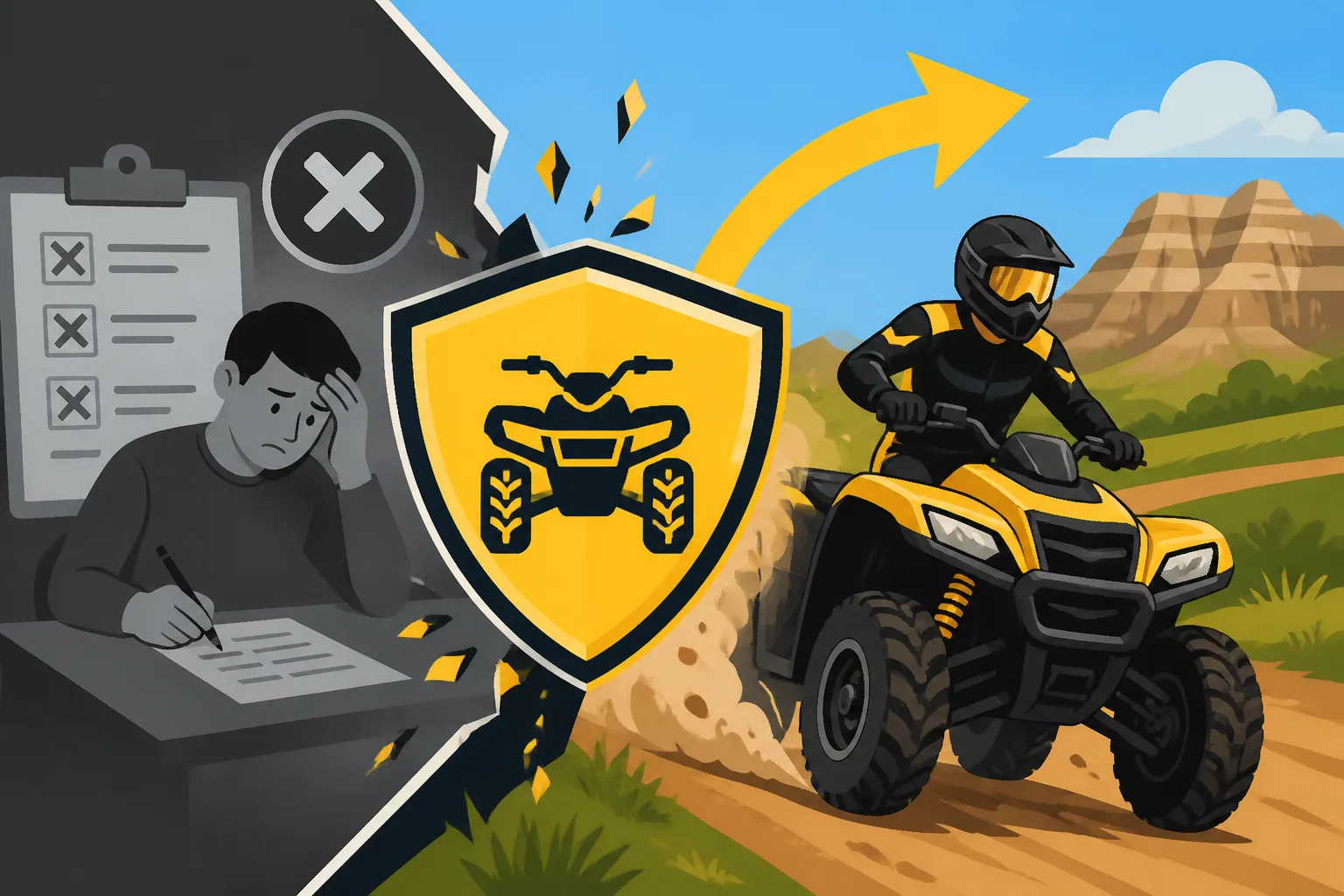
One of the biggest concerns riders voice is the idea of having to take a completely new driving test, perhaps similar to getting a motorcycle license, just to drive their ATV on a gravel road to get to a trailhead or the local general store. This worry is completely understandable, especially for those who have been driving cars for decades and might feel put on the spot with a specialized off-road vehicle test. Many envision a demanding course with cones and specific maneuvers, all while trying to master a machine that handles very differently from their daily driver. It can feel like an unnecessary hurdle, adding stress and expense to the simple desire to enjoy their machine more broadly.
However, in South Dakota, the reality is often a sigh of relief for most riders. The state's regulations, while specific, don't typically demand a separate driving test for an ATV or UTV if it meets certain criteria to be plated as a motor vehicle. Your existing, valid driver's license for a standard passenger vehicle is usually what you'll need. This is a crucial distinction that often gets lost in casual conversations about street legality. The focus shifts from demonstrating new driving skills on a specific type of vehicle to ensuring the vehicle itself is compliant and you, the operator, possess a fundamental level of driving competency already proven by your standard license.
Why the Engine Size Rule Matters for Road Use
South Dakota's approach to plating ATVs for road use hinges significantly on engine displacement. This isn't just an arbitrary number; it's a key differentiator in how the state categorizes these machines for highway use. For an ATV to be eligible for a standard motorcycle plate—which is what you'll typically aim for to achieve street legality—it generally needs to meet a minimum engine size requirement. Specifically, for four-wheeled ATVs, this threshold is often 200 cubic centimeters (200cc). If your quad, side-by-side, or other off-road vehicle falls below this displacement, you'll find it incredibly difficult, if not impossible, to get a standard plate that allows for road use. This rule is designed to ensure that vehicles sharing the road have a certain level of power and capability to keep up with traffic and maintain stability, even if only for short distances or on less-traveled routes.
The rationale behind this isn't about making things difficult; it's about road safety and integrating these machines into the existing vehicle classification system. A smaller engine might not have the acceleration needed to safely merge or the sustained speed to avoid becoming a hazard on roads where even low speeds are faster than an ATV's top end. For those with smaller youth models or machines primarily designed for very slow, technical off-road work, this rule can be a letdown. It means that beloved family ATV might only ever be suitable for private property or designated trails. Understanding [South Dakota's 200cc Motorcycle Licensing Rule] is paramount to determining if your specific machine can even begin the journey toward road legality.
Differentiating Plates from Permits and Safety Courses
It's vital to understand the difference between obtaining a license plate for road use, needing an off-road permit for trails, and any potential safety course requirements. These three elements serve distinct purposes in South Dakota, and confusing them can lead to unexpected fines or denied access. A license plate signifies that your ATV or UTV has met the state's requirements to be operated on public roadways, treating it much like any other motor vehicle. This typically involves titling, paying excise tax, and ensuring the machine has the necessary safety equipment. When you have a plate, the focus shifts to your driver's license, not a separate ATV driving test.
On the other hand, an off-road permit, often referred to as a motorized trail permit, is specifically for accessing designated off-road trail systems, like those found in the Black Hills National Forest. This permit has nothing to do with road legality and doesn't grant you permission to ride on public highways. It's an access pass for specific recreational areas. You could have a fully plated ATV and still need a trail permit to ride certain trails, and conversely, you might have a non-plated machine with a permit that is restricted solely to those trails and private land.
Lastly, safety courses are generally recommended for all riders, especially youth, to learn safe operating practices. However, unlike some other states, South Dakota does not mandate a safety course for adult riders to obtain a driver's license or plate an ATV for road use. While a safety course is always a good idea for improving skills and awareness, it's not a prerequisite for getting your machine on the road legally in South Dakota. Keeping these distinctions clear will save you a lot of headache and ensure you're compliant with the right regulations for your intended riding environment.
South Dakota's Path to Street Legality for ATVs
Getting your ATV or UTV truly "street legal" in South Dakota isn't just about sticking a plate on it. It's a comprehensive process that involves meeting specific vehicle requirements, understanding the titling process, and ensuring you, the operator, are properly licensed. It's about transforming your off-road toy into a recognized motor vehicle capable of sharing public thoroughfares.
Meeting the Minimum Engine Displacement for a Plate
As we've touched upon, engine displacement is a critical factor in South Dakota's determination of whether an ATV or UTV can be plated for road use. For four-wheeled off-road vehicles like quads and side-by-sides, the magic number is generally 200cc. If your machine's engine is smaller than this, it's highly unlikely you'll be able to get it titled and registered for road use as a motorcycle. This rule isn't unique to South Dakota; many states have similar guidelines to ensure that vehicles operating on public roads can maintain a reasonable speed and safely interact with other traffic. For two-wheeled dirt bikes, the threshold is often 120cc.
This means before you even dream of riding to the gas station or across town, you need to check your owner's manual or the vehicle's specifications. If you own an older machine or a youth model, you might find it doesn't meet this basic requirement. This can be a hard truth for some, as it might mean the machine you love for the trails won't be able to legally touch pavement beyond private property or specific ditch riding areas. It's crucial to understand [What South Dakota Counts as an Off-Road Vehicle] and how its specific definition plays into these engine size requirements.
Essential Equipment for Road-Legal Operation
Once you've confirmed your machine meets the engine displacement rule, the next big step is ensuring it's equipped with all the necessary safety features to be considered road-legal. This isn't just a suggestion; it's a legal mandate that can vary slightly from what's required for a typical passenger car, but aims for the same level of safety and visibility. You'll need working headlights and brake lights, which are often standard on most modern ATVs and UTVs, but they must be functional and visible from appropriate distances. Turn signals are another critical addition, allowing you to clearly signal your intentions to other drivers. Many off-road machines don't come with turn signals from the factory, so this is a common aftermarket upgrade. Companies like SuperATV offer a wide range of turn signal kits and accessory lights designed to integrate seamlessly into various ATV and UTV models, making the conversion much easier.
Beyond lighting, you'll need at least one rear-view mirror to see traffic behind you, and an audible warning device, like a horn, to alert others to your presence. These seem like basic safety items, but for a machine designed primarily for dirt, they might be missing or insufficient for road standards. A license plate bracket with illumination is also a must, so your plate is visible at all times, day or night. All these components must be in good working order and properly installed before you can expect to pass any inspection or confidently drive on public roads. Neglecting any of these can lead to fines or even your machine being deemed unfit for the road. For a comprehensive checklist, refer to [Equipment a South Dakota Road Machine Needs].
The Importance of a Valid Driver's License
Here's where we get to the core of why a separate driving test isn't typically required: your existing driver's license. In South Dakota, if your ATV or UTV is properly titled and plated for road use as a motorcycle (which is generally the classification for street-legal ATVs), then the operator must possess a valid driver's license. This means your standard Class D driver's license, the one you use to drive your car or pickup, is usually sufficient. You don't need a specific motorcycle endorsement on that license, nor do you need to pass a new driving test on your ATV. The state recognizes that your general driving competency, as demonstrated by obtaining your regular driver's license, is adequate for operating these machines on public roads, provided the machine itself is road-legal.
However, this doesn't mean you can just hop on. It implies that you understand the rules of the road, traffic laws, and safe driving practices. Operating an ATV on pavement requires different skills and awareness than riding off-road. You need to be acutely aware of traction differences, higher centers of gravity, and the fact that you're much smaller and less visible than other vehicles. While no additional test is required, common sense and caution are paramount. Being caught without a valid driver's license while operating a plated ATV on a public road would result in the same legal consequences as driving any other motor vehicle without a license, potentially including fines, impoundment, and legal action. For further details on this, check [South Dakota Driver's License Rules for ATVs].
The Driver's License Exception: What It Means for ATV Riders
The "exception" refers to the fact that, unlike traditional two-wheeled motorcycles that almost universally require a specific motorcycle endorsement (often called an M-class license or similar) and a corresponding driving test, street-legal ATVs and UTVs in South Dakota typically do not require this additional endorsement. This is a significant relief for many riders who want the flexibility of road use without the burden of another specialized driving exam.
How a Motorcycle Endorsement Isn't Always Required
This is often the biggest "aha!" moment for many ATV riders in South Dakota. When an ATV or UTV meets the state's criteria for road-legal operation—including the engine displacement requirements and the necessary safety equipment—it is typically classified for registration purposes in a way that allows a standard driver's license to suffice. The state does not generally categorize these four-wheeled machines as requiring the same "M" endorsement as a traditional two-wheeled motorcycle. Imagine the scenario: you've spent years driving your car, confidently navigating highways and city streets. Now you want to use your side-by-side to run errands or connect trails. The thought of having to learn to balance and operate a two-wheeled motorcycle, and then pass a specific test, just for your four-wheeled ATV can be a major deterrent.
Thankfully, South Dakota's framework avoids this specific hurdle. You don't need to demonstrate proficiency on a motorcycle to legally drive your plated ATV on the road with your regular Class D license. This exception acknowledges the fundamental differences in operating characteristics between a two-wheeled motorcycle and a four-wheeled ATV. While both are "motorcycles" in a broad legal sense for registration purposes, the practical driving requirements are distinct enough for the state to make this allowance. This significantly lowers the barrier to entry for riders wanting to make their machines street-legal, allowing them to focus on the vehicle's compliance rather than their personal licensing credentials beyond their existing driver's license.
The Class 2 Misdemeanor and Its Consequences
While you might not need a motorcycle endorsement, operating a plated ATV on a public road without any valid driver's license at all is a serious offense in South Dakota. This isn't a minor infraction; it falls under the category of a Class 2 Misdemeanor. The implications of this are far-reaching and can have significant consequences for the rider. A Class 2 Misdemeanor is not just a traffic ticket; it's a criminal offense that goes on your permanent record. It can result in substantial fines, potentially hundreds of dollars, and could even lead to jail time, though for a first offense of this nature, a fine is more common.
Beyond the immediate legal penalties, a misdemeanor conviction can impact other areas of your life. It might affect future employment opportunities, especially for jobs requiring a clean driving record or background check. Your insurance rates could skyrocket, or your policy might even be canceled. Furthermore, if you're involved in an accident while operating without a valid license, your liability could be significantly increased, and your insurance company might refuse to cover damages, leaving you financially exposed. The South Dakota Highway Patrol takes these regulations seriously, and a roadside stop can quickly escalate if you don't have the proper licensing. It's simply not worth the risk to operate your plated machine without your valid driver's license in your possession.
When the Exception Doesn't Apply
It's crucial to understand that while the "no separate motorcycle endorsement" rule is a major benefit, it's not a blanket exemption for all situations. There are specific instances where this exception might not apply, or where additional rules come into play that riders need to be aware of.
Firstly, if your machine doesn't meet the fundamental requirements to be plated as a motor vehicle in the first place—such as failing the engine displacement rule (e.g., being under 200cc for a quad)—then the entire discussion of driver's license exceptions becomes moot. The vehicle simply cannot be legally operated on public roads, regardless of your license.
Secondly, this exception primarily applies to the operator's license. It does not exempt the vehicle from needing all the proper [Equipment a South Dakota Road Machine Needs] like mirrors, horns, and lights. If your machine isn't fully equipped and compliant, even with a valid driver's license, you'll still be subject to citations.
Thirdly, certain specialized vehicles or custom builds might be evaluated differently. While many UTVs can be plated, exceptionally large or heavy custom machines might fall into a different vehicle classification, potentially requiring different licensing. Always verify with the Department of Motor Vehicles or a county treasurer if you have a unique setup.
Lastly, while South Dakota may not require a specific motorcycle endorsement for plated ATVs, if you travel to other states, their rules might differ. Some neighboring states do require a motorcycle endorsement for any open-air motor vehicle, regardless of whether it has two or four wheels. Therefore, if you plan on taking your street-legal South Dakota ATV on a road trip, always check the local laws of your destination and any states you'll be passing through. Ignorance of out-of-state laws is not a valid defense.
Equipping Your ATV for South Dakota Roads
Transitioning your off-road machine from the dirt to the street involves more than just getting a license plate. It demands a suite of modifications and additions to ensure it meets the legal and safety standards for public road use in South Dakota. This isn't just about avoiding fines; it's about making your presence known and protecting yourself and others on shared roadways.
Lighting Requirements for Safe Road Travel
When you take your ATV or UTV onto South Dakota's roads, proper lighting becomes non-negotiable. Your machine needs to be as visible as any other vehicle, whether you're driving in broad daylight or after dusk. This means your machine must be outfitted with at least one, and ideally two, functional headlights that project a white light capable of illuminating the road ahead. These aren't just for seeing; they're primarily for being seen. Many ATVs come with decent headlights for trail riding, but you need to ensure they meet the state's standards for brightness and beam pattern for road use. You'll also need a working taillight that emits a red light to the rear, visible from a specified distance.
Crucially, you must have functional brake lights. These are essential for signaling your intentions to traffic behind you. When you apply the brakes, the red light should illuminate clearly. Often, ATVs have a single taillight that brightens when the brakes are applied. For older models, or if you're building a custom machine, you may need to add these. Furthermore, turn signals are required. These are often the biggest aftermarket addition for riders converting their machines. You'll need amber turn signals on both the front and rear, indicating clearly when you plan to change lanes or turn. Companies like SuperATV specialize in these kinds of conversion kits, offering comprehensive wiring harnesses and LED lights that make upgrading your machine to road-legal standards much simpler and more reliable than piecing together individual components.
Visibility and Warning Systems: Mirrors and Horns
Beyond lighting, your ability to see your surroundings and communicate with other drivers is critical for road safety. A rear-view mirror is not optional; it's a mandatory piece of equipment for any vehicle operating on South Dakota roads. This mirror allows you to monitor traffic approaching from behind, crucial for making lane changes, turning, or simply being aware of your environment. Most ATVs and UTVs designed primarily for off-road use might come with small, inadequate mirrors, or none at all. You'll likely need to install a properly sized mirror that offers a clear and unobstructed view to the rear. Some riders opt for a single central mirror, while others prefer side mirrors for a wider field of view.
Equally important is an audible warning device, commonly known as a horn. This doesn't have to be a multi-tone air horn like a semi-truck, but it must be functional and loud enough to be heard by other drivers to alert them to your presence or to avoid potential hazards. Many ATVs and UTVs have a small, often weak, horn button from the factory. You'll need to ensure yours meets the state's requirements for sound and functionality. These warning devices are not just for emergencies; they're everyday tools for safe interaction on public roads. Imagine needing to warn a driver who is drifting into your lane or to get the attention of a pedestrian; a reliable horn is essential. These small but significant additions contribute immensely to your safety profile on the road.
Specialized Gear and Accessories
While the core requirements for lights, mirrors, and horns cover the basics, many riders consider additional specialized gear and accessories to enhance safety and compliance when venturing onto South Dakota's roads. For instance, some riders opt for brighter, DOT-approved LED headlights and taillights for maximum visibility, particularly if they plan to do a lot of night riding. Reflective tape on the sides and rear of the machine can also increase your visibility, especially on unlit rural roads.
Another area to consider is tire choice. While knobby off-road tires are perfect for mud and rocks, they can handle very differently on pavement, especially at higher speeds or in wet conditions. They can wear quickly, create excessive noise, and reduce grip. Many riders who frequently drive on the road will switch to a more street-oriented or all-terrain tire with a shallower, denser tread pattern. These tires offer better longevity, smoother rides, and improved traction on asphalt and gravel. Companies like SuperATV not only provide essential road-legal conversion kits but also offer a range of tires, wheels, and suspension components that can improve your machine's on-road performance and comfort. For example, a wider stance kit from SuperATV could enhance stability, or a lift kit might be paired with larger, more road-friendly tires. Investing in robust, weather-resistant storage solutions is also practical, allowing you to carry your license, registration, and any necessary tools safely and securely while on the road.
| Required Equipment for South Dakota Road Use | Purpose | Common Aftermarket Need |
|---|---|---|
| Headlights (White) | Visibility to others, illuminate road | Upgrade brightness |
| Taillight (Red) | Visibility to the rear | Ensure functionality |
| Brake Lights (Red, Brighter) | Signal slowing/stopping | Ensure functionality |
| Turn Signals (Amber, Front & Rear) | Indicate direction changes | Often required add-on |
| Rear-view Mirror | Monitor traffic behind | Often required add-on |
| Horn (Audible Warning Device) | Alert others to presence/danger | Ensure functionality |
| License Plate Bracket & Illumination | Secure & illuminate license plate | Often required add-on |
| DOT-Approved Tires (Recommended) | Better pavement grip, wear, and noise | Common upgrade |
Navigating South Dakota's Ditch Riding Rules
Riding in the ditches beside public roads is a unique aspect of ATV and UTV culture in South Dakota, offering a way to traverse terrain that might not be on designated trails or main roadways. However, this privilege comes with a very specific set of rules and limitations that riders must understand to stay legal and safe. It's not a free-for-all, and misunderstanding the rules can quickly lead to citations.
The Ditch Riding Privilege and Its Limitations
South Dakota law grants a specific privilege for ATVs and UTVs to be operated in the bottom of a highway ditch or on the back-slope of a highway, under certain conditions. This is a crucial distinction: it's not permission to ride on the paved shoulder, the main travel lanes, or even just any grassy area adjacent to the road. The law is quite explicit about the "bottom of the ditch" or "back-slope," implying areas outside the direct flow of vehicular traffic. This privilege is especially valuable in rural areas, allowing riders to connect between private properties, access trailheads, or simply enjoy a ride without needing to be fully street-legal or on designated trails at all times.
However, this privilege is not without its limitations. For instance, ditch riding is generally prohibited along interstate highways, even in their ditches. The speed limit in a ditch is also restricted, often to 20 mph or less, depending on the specific circumstances and local ordinances. You cannot ride in ditches that are snowmobile trails, bike trails, or within the limits of incorporated municipalities unless specifically designated otherwise. It's also important to remember that this privilege doesn't supersede private property rights. If a ditch is on private land, you still need the landowner's permission. Understanding the nuances of [South Dakota's Ditch Riding Rule] is essential for any rider venturing into these areas.
County Opt-Outs and Regulatory Signs
Here's where ditch riding gets complicated: individual counties in South Dakota have the authority to "opt out" of allowing ditch riding within their jurisdiction. This means that while the state generally permits it, a county can enact an ordinance to ban or restrict it on specific roads or county-wide. This local control means that the rules can change as you cross county lines, making it challenging for riders, especially those from out of state or just passing through. A ditch that was perfectly legal to ride in one county might become off-limits just a few miles down the road.
To address this, South Dakota law mandates that counties which opt out of ditch riding must post clear regulatory signs indicating the prohibition. These signs should be visible at entry points to the county or along roads where the ban is in effect. As a rider, it's your responsibility to be vigilant for these signs. Riding past a "No ATV Ditch Riding" sign can instantly turn a legal ride into a citation. It's always a good idea to check with the local county sheriff's office or highway department if you're unsure about the ditch riding status in an area you plan to visit, especially if you're exploring new territory like [Riding a Ditch Beside a State Route]. Never assume ditch riding is permitted everywhere; always look for the signs and, when in doubt, refrain from riding in the ditch.
Crossing Highways and Intersections Safely
Even when riding in legal ditches, there will inevitably be times when you need to cross a paved highway, a gravel road, or navigate an intersection. South Dakota law provides specific guidelines for these situations, emphasizing safety and minimizing interference with vehicular traffic. When crossing a public highway, you are generally required to stop, yield to all oncoming traffic, and proceed across the road in the most direct and safest manner possible, at a right angle to the road. You should not ride along the pavement, even for a short distance, to find a better crossing point; the intent is a direct, quick crossing.
The law is clear that no county can bar an ATV from crossing a public highway. This means that even in counties that have opted out of ditch riding, you still retain the right to cross their roads, provided you do so safely and legally. However, this doesn't grant you carte blanche to ride the road itself. After crossing, you must immediately re-enter the ditch or move to private property if that's your destination. At intersections, you must adhere to all traffic laws, including stop signs, yield signs, and traffic lights, just as any other motor vehicle would. Your visibility as an ATV or UTV is lower than that of a car, so exercising extreme caution and making eye contact with drivers before proceeding is vital. This is one of the most hazardous parts of ditch riding, and rider awareness is paramount to avoid accidents.
Age, Helmets, and Eye Protection on South Dakota Roads
Safety regulations, particularly concerning age, helmets, and eye protection, are designed to minimize injury risks for ATV and UTV riders. While South Dakota's rules might seem less stringent than some other states, they are still clear and enforceable, especially when operating on public roads or in ditches.
Helmet Requirements for Younger Riders
In South Dakota, the helmet law for ATV and UTV riders is specific to age. If you are under the age of 18, wearing a helmet is mandatory when operating an ATV or UTV on public land, ditches, or roads. This rule is in place to protect younger, often less experienced, riders who may be more prone to accidents or less capable of reacting quickly to hazards. The science is unequivocal: helmets save lives and prevent severe head injuries. For parents or guardians, this means ensuring that any teenager or child operating a machine on public thoroughfares is properly outfitted with a DOT-approved helmet.
Once a rider reaches their 18th birthday, the mandatory helmet law no longer applies to them in South Dakota. This is a key distinction from many states where helmets are required for all riders, regardless of age, when on public roads. However, even though it's not legally mandated for adults, wearing a helmet is always strongly recommended. Accidents can happen to anyone, regardless of age or experience, and the risks of head injury are severe. A helmet provides crucial protection that no amount of experience can replace. So, while the law makes an exception for adults, personal safety should always be the priority. For more detailed information on specific requirements, refer to [South Dakota Helmet Rules for ATV Riders].
Eye Protection: A Universal Rule
Unlike helmets, eye protection is a universal requirement for all ATV and UTV riders in South Dakota, regardless of age, when operating on public roads or in ditches. This means if you're on a plated machine or riding legally in a ditch, you must have adequate eye protection. This isn't just about complying with the law; it's about protecting one of your most vital senses from a myriad of hazards. Kicked-up dust, gravel, insects, branches, and even harsh wind can cause significant injury or impair your vision, leading to dangerous situations.
Approved eye protection typically includes goggles, a face shield on a helmet, or safety glasses designed for riding. Regular eyeglasses or sunglasses might not offer sufficient protection against impacts or wind buffeting. The key is that the eye protection must be impact-resistant and provide a clear field of vision. Furthermore, there are rules about tinting. You cannot use eye protection with a tint that is so dark it obscures your vision, especially at night or in low-light conditions. Generally, a tint lighter than 35 percent is acceptable. This ensures that while your eyes are protected from debris, your ability to see the road, other vehicles, and potential hazards remains unimpaired. Failing to wear proper eye protection can result in a citation and, more importantly, put your vision and safety at serious risk.
Supervising Youthful Riders
When it comes to youth riders, South Dakota has specific rules about supervision, particularly concerning public land and ditch riding. While the helmet law applies to those under 18, there are also minimum age requirements for operating ATVs and UTVs in certain public areas. Generally, a child must be at least 12 years old to operate an ATV in a ditch or on certain public lands. However, this often comes with a crucial caveat: they must be under the direct supervision of an adult who is at least 18 years old. "Direct supervision" usually means the adult must be riding with the youth, either on the same machine (if designed for two riders) or on a separate machine in close proximity, able to intervene or provide instruction.
This adult supervision requirement is designed to ensure that younger riders are learning safe operating practices, understanding the rules, and responding appropriately to changing conditions. It provides a layer of safety and mentorship that is vital for developing responsible riders. Parents and guardians bear a significant responsibility in not only outfitting their children with the proper safety gear but also actively supervising their riding activities on public access areas. Allowing an underage or unsupervised youth to ride in a public ditch or on a road can lead to citations for both the child and the supervising adult, in addition to the inherent safety risks. Always confirm the specific age and supervision rules for the area you plan to ride, as some local jurisdictions or managed recreational areas may have even stricter requirements.
Registering Your ATV for South Dakota Road Use
The journey to making your ATV or UTV street-legal in South Dakota culminates in the registration process. This isn't just a formality; it's the official recognition that your off-road machine is now a motor vehicle capable of sharing public roads. Understanding this process, from titling to fees, is essential to ensure compliance and avoid any unwelcome surprises.
The Titling Process for Road-Legal ATVs
The first and most fundamental step in registering your ATV or UTV for road use in South Dakota is obtaining a title for it. If you bought your machine new from a dealer, they typically handle the initial paperwork to get you a manufacturer's certificate of origin (MCO) or initial title. If you bought it used, especially from a private seller, you must ensure you receive a properly signed-over title from the previous owner. Without a clear title, you cannot prove ownership, and therefore, you cannot register the machine. This step is handled at your local county treasurer's office. [Titling an ATV in South Dakota] involves presenting proof of ownership, filling out the necessary application, and having the vehicle inspected if it's an out-of-state transfer or has never been titled before.
The treasurer's office will review your documentation, verify the Vehicle Identification Number (VIN), and ensure all forms are correctly completed. They will then process your application, leading to the issuance of a South Dakota title in your name. This title is the legal document proving you are the owner of the vehicle. Only after you possess a valid South Dakota title can you proceed with the registration and plating process for road use. It's a sequential process, and rushing or skipping steps here will only create headaches down the line. If you're buying a used machine, always verify the title status before purchase to avoid issues with [South Dakota ATV Title Transfer].
Fees and Taxes Associated with Plating Your Machine
Getting your ATV or UTV plated for road use in South Dakota involves a series of fees and taxes that contribute to the state's infrastructure and services. The primary cost you'll encounter is the excise tax. South Dakota levies a 4 percent excise tax on the purchase price of the vehicle, whether new or used. This tax is typically paid at the time of titling. If you bought your machine for $10,000, for example, you'd owe $400 in excise tax. It's an unavoidable cost that applies to most motor vehicle purchases. Be prepared for this significant expense when you budget for your street-legal conversion.
Beyond the excise tax, there are several other, smaller fees that stack up. You'll pay a title fee, which is a relatively modest amount for the actual paper title. There's also an annual registration fee, which can vary slightly based on the age and weight of your machine, but is generally designed to be affordable. A technology fee has also been implemented, which helps fund the state's motor vehicle systems. You might also encounter a lien notation fee if you financed your purchase, or a duplicate title fee if you ever lose your original. These fees are collected by the county treasurer's office. It's important to understand that these costs are separate from any trail permits you might purchase for off-road riding. For a detailed breakdown of what to expect, check out [South Dakota ATV Title Cost] and [South Dakota ATV Title and Sales Tax].
Maintaining Compliance and Avoiding Penalties
Once your ATV or UTV is titled, registered, and properly plated for road use, your responsibility shifts to maintaining compliance. This means several things. First, you must renew your registration annually. The county treasurer's office will typically send you a renewal notice, but it's ultimately your responsibility to ensure your tags are current. Driving with expired registration can lead to fines and potential impoundment of your machine.
Second, always carry your proof of registration and a valid driver's license with you when operating your plated ATV on public roads. Law enforcement officers may request these documents during a traffic stop, and being unable to produce them can cause delays and potential citations. Third, ensure your machine continues to meet all equipment requirements. Headlights, brake lights, turn signals, mirrors, and horns must remain functional. A burnt-out bulb or a broken mirror can be a reason for a stop and a citation.
Lastly, be mindful of where you ride. A plated ATV is generally permitted on most public roads, but certain restrictions still apply. For example, you cannot ride on interstate highways, and some municipal ordinances might restrict ATV use on specific city streets, even if plated. Always obey posted traffic signs and speed limits. Failing to maintain compliance can result in a range of penalties, from minor fines to more severe consequences like impoundment or legal action, especially if repeated offenses occur. The goal is safe and legal enjoyment, so staying on top of your obligations is crucial.
Real-World Scenarios and Practical Advice for South Dakota Riders
Understanding the rules on paper is one thing, but knowing how they apply in real-life situations is where the rubber meets the road—or in our case, the gravel. South Dakota offers incredible opportunities for ATV and UTV enthusiasts, but navigating these experiences legally and safely requires practical know-how.
Planning a Multi-Town Ride in the Black Hills
Imagine you're planning a trip to the Black Hills, wanting to explore not just the extensive trail systems but also the charming towns like Deadwood, Sturgis, and Spearfish. You've gone through the effort of making your UTV street-legal: it's titled, plated, has all the necessary lights and mirrors (maybe some shiny new ones from SuperATV!), and you have your valid driver's license. This opens up a whole new world of possibilities. Instead of trailering your machine from one trailhead to another, you can ride your plated UTV directly from your campsite or cabin to a local eatery in Hill City, then hop onto a forest road to access a trail, and even continue through Custer to see the Crazy Horse Memorial.
However, planning such a ride requires careful consideration. While your UTV is street-legal, remember that speed limits on paved roads are often higher than what's comfortable or safe for an ATV/UTV. Stick to secondary roads, gravel roads, and designated forest roads where possible. Be acutely aware of your visibility to other traffic, especially motorcyclists during Sturgis Rally Week when the roads are packed. Have a map that clearly distinguishes public roads from trails, and be aware of any local ordinances in towns that might restrict ATV access on specific streets, even for plated machines. Always carry your documentation – license, registration, and proof of insurance – because you might encounter a check by a county sheriff or forest service ranger. This ability to seamlessly transition between trails and towns on your own machine is a huge benefit of going street-legal. [Riding a Black Hills Forest Road in Fog] can be challenging, so always check weather and road conditions before setting out.
Dealing with Law Enforcement Encounters
Even when you're doing everything right, you might still encounter law enforcement. It could be a routine traffic stop, a checkpoint near a popular riding area, or simply an officer checking on activity. Knowing how to handle these encounters respectfully and knowledgeably can make all the difference. If an officer signals you to stop, do so safely and promptly. Keep your hands visible, preferably on the handlebars or steering wheel.
When the officer approaches, be polite and cooperative. They will likely ask for your driver's license, vehicle registration, and proof of insurance. Having these documents readily accessible, perhaps in a waterproof pouch, will expedite the process. Clearly state that your ATV/UTV is legally plated for road use in South Dakota. The officer might not immediately recognize the legality of your machine, especially if they are accustomed to seeing ATVs only off-road. You may need to calmly explain that it meets the state's requirements. If there's an issue with your equipment, like a burnt-out light, acknowledge it and state your intention to fix it promptly. Most officers appreciate cooperation and preparedness. Staying calm and providing the requested information will ensure a smooth interaction and allow you to continue your ride.
The Benefits of a Properly Licensed and Equipped ATV
The benefits of going through the process of properly licensing and equipping your ATV or UTV for South Dakota roads are immense. Foremost is the unparalleled flexibility it offers. No longer are you strictly limited to private land or designated trails. You can connect trails, access fuel or food in town, ride from your camp to a scenic overlook, or even use your machine for practical tasks like checking mail or short errands on rural roads. This versatility enhances the enjoyment and utility of your investment significantly. [South Dakota Rules for Riding a Gravel Road] become part of your everyday riding.
Beyond flexibility, legality brings peace of mind. You won't have to worry about the stress of breaking the law or facing fines. You're a recognized road user, playing by the rules. This also extends to safety; by adding turn signals, mirrors, and appropriate lighting, you're making your machine much safer for interaction with other vehicles, reducing the risk of accidents. While the initial investment in parts and time might seem like a hurdle, the long-term benefits in freedom, utility, and safety far outweigh the effort. It transforms your off-road vehicle into a true multi-purpose machine, ready for adventure both on and off the beaten path in the great state of South Dakota.
Disclaimer
This article is for general informational purposes only and does not constitute professional advice. Laws, prices and regulations vary by location and change over time. Consult a qualified professional for guidance on your specific situation.