Teaching a Child on Ranch Ground
Teaching a child on ranch ground in South Dakota can feel simpler than planning a ride on public trails, but private land does not make every machine or situation safe. The key is to confirm where the child may ride, choose equipment they can control, and build skills gradually. It also helps to know when private-ground rules stop applying—especially if a route reaches a public road or trail.
Confirm the land is private and the child has permission to ride
A ranch can be a useful place for a new rider to learn because the landowner can choose a quiet, controlled area. But first establish who controls the ground and what permission covers. A relative’s ranch, leased pasture, or farm road is not automatically open to every visitor. Ask the owner or the person authorized to manage the land, and agree on where the child may ride, when, and with what supervision.
Make the permitted area specific. “Stay on the ranch” can be hard for a child to interpret if the property has several pastures, public-road boundaries, neighboring parcels, or trails that lead away from the yard. Walk or drive the route before the lesson. Mark clear turnarounds and no-go areas, and point out fences, gates, water, livestock, equipment, steep banks, and roads. A fence is not a safe barrier to approach at speed, and a gate should be left as the ranch owner expects it to be.
If the property is leased, permission from the person using the land may not be enough. Check with the landowner or leaseholder who has authority to allow recreational riding. Written permission can prevent confusion, particularly when a child is visiting with another family or the ranch has several operators. For a broader look at access and consent, see South Dakota Landowner Permission Rules.
Keep the learning area away from active ranch work. A tractor, stock trailer, irrigation equipment, moving livestock, or a worker coming around a blind corner can change a quiet practice area into a hazard quickly. Arrange a time when the route is not being used for work, and make sure other people on the property know a child will be riding. Do not let the child ride near animals unless the owner has specifically approved it and an experienced adult is managing the situation.
A private ranch is not a public trail
A permit requirement depends on where the machine is being ridden, not simply where it is stored or who owns it. A child riding wholly on private ranch ground generally does not need a Black Hills motorized trail permit just to practice there. That does not mean the same machine can continue onto a designated public motorized trail without meeting the applicable requirements. Review When Ranch-Only Riding Needs No Trail Permit before planning a route that might leave the property.
Private ground also does not make a public road, highway ditch, or public trail private. A route that crosses a road or joins public land needs separate planning. Do not let a child follow a ranch track beyond its boundary just because it looks like a continuation of the same route. Confirm the boundary and access rights first.
South Dakota’s rules for public land and rights-of-way are not a substitute for a ranch’s safety plan. For example, an age rule associated with ditch riding is not a general recommendation that a child of that age is ready to ride alone on a ranch. See South Dakota Minimum Age to Ride Public Land for the public-land context, and keep private-property decisions focused on the child’s ability, the machine, and the hazards on that particular property.
| Situation | What to check before the child rides |
|---|---|
| Riding entirely on ranch ground | Permission, boundaries, a controlled practice area, and active ranch work nearby |
| Using a private ranch road | Whether it is truly private and whether the owner allows recreational use |
| Crossing or riding along a public road | The rules for that road, the machine, the rider, and any crossing |
| Entering a designated motorized trail | Whether the machine needs a permit and whether the route is open |
| Riding on leased or shared ground | Who has authority to give permission and which areas are excluded |
When the route will stay on private land, focus on practical access and safety. When it touches a public area, stop and check the rules for that area before riding. South Dakota Rules for Riding Private Property explains why permission and property status matter, while South Dakota Rules for Riding Federal Land is relevant if a planned ride enters federal land.
Match the machine to the child, not the other way around
A child should be able to operate the machine without stretching, straining, or relying on an adult to correct every mistake. A machine that is too large or powerful can overwhelm a beginner, even on a flat field. Consider the child’s age, height, strength, attention, coordination, and experience, as well as the machine’s size and controls. Follow the manufacturer’s age and operating guidance; do not assume that a child can safely use a full-size adult machine because they can reach the seat.
Before starting, the child should be able to reach and use the controls comfortably while seated. They need to understand how to start, stop, steer, shift if applicable, and use the throttle without gripping it accidentally. They should also know how to shut the machine off and what to do if it stalls. If the controls are difficult to reach or the child cannot turn the machine smoothly, choose a better-sized machine or wait.
An adult should inspect the machine before each practice session. Check the brakes, throttle return, steering, tires, chain or drive components, lights if fitted, and any safety features the manufacturer provides. Confirm that the machine is in good repair and that the child knows how to use its controls. A familiar machine in working order is a better teaching tool than an unfamiliar one that has not been checked.
Protective gear matters even at low speed. A properly fitted helmet should be non-negotiable for practice, along with eye protection, gloves, sturdy footwear that covers the ankles, and clothing that covers arms and legs. A helmet that shifts, pinches, or blocks vision is not a good fit. Choose gear the child can wear correctly for the whole ride, not just gear that is available in an adult size. When shopping through Amazon or another retailer, check the manufacturer’s sizing and safety information, and make sure the helmet fits the child in person before relying on it.
South Dakota’s helmet rules can depend on the riding context and rider’s age. Do not treat ranch ownership as a reason to skip protective equipment, or assume that a rule for a road or public setting answers every question about private-ground riding. The practical choice is to require a helmet during instruction and confirm the legal requirement for any public-road or public-land use. South Dakota Helmet Rules for ATV Riders covers the age-related context.
Eye protection is also important: dust, insects, branches, and small debris can make it hard to see. Use goggles or other suitable protection that stays in place and does not interfere with the helmet. For more detail on the state requirement, see South Dakota Eye Protection Rules for Riders.
A safety course can be useful even when it is not required for the child’s private-ground practice. It can give the child and supervising adult a shared vocabulary for safe starts, stops, turns, and hazard awareness. South Dakota does not make a safety course a universal prerequisite for every ATV ride, but that is not a reason to skip instruction. Check South Dakota ATV Safety Course Requirements if the child may later ride in a setting where different rules apply.
Teach in small steps with an adult in control of the setting
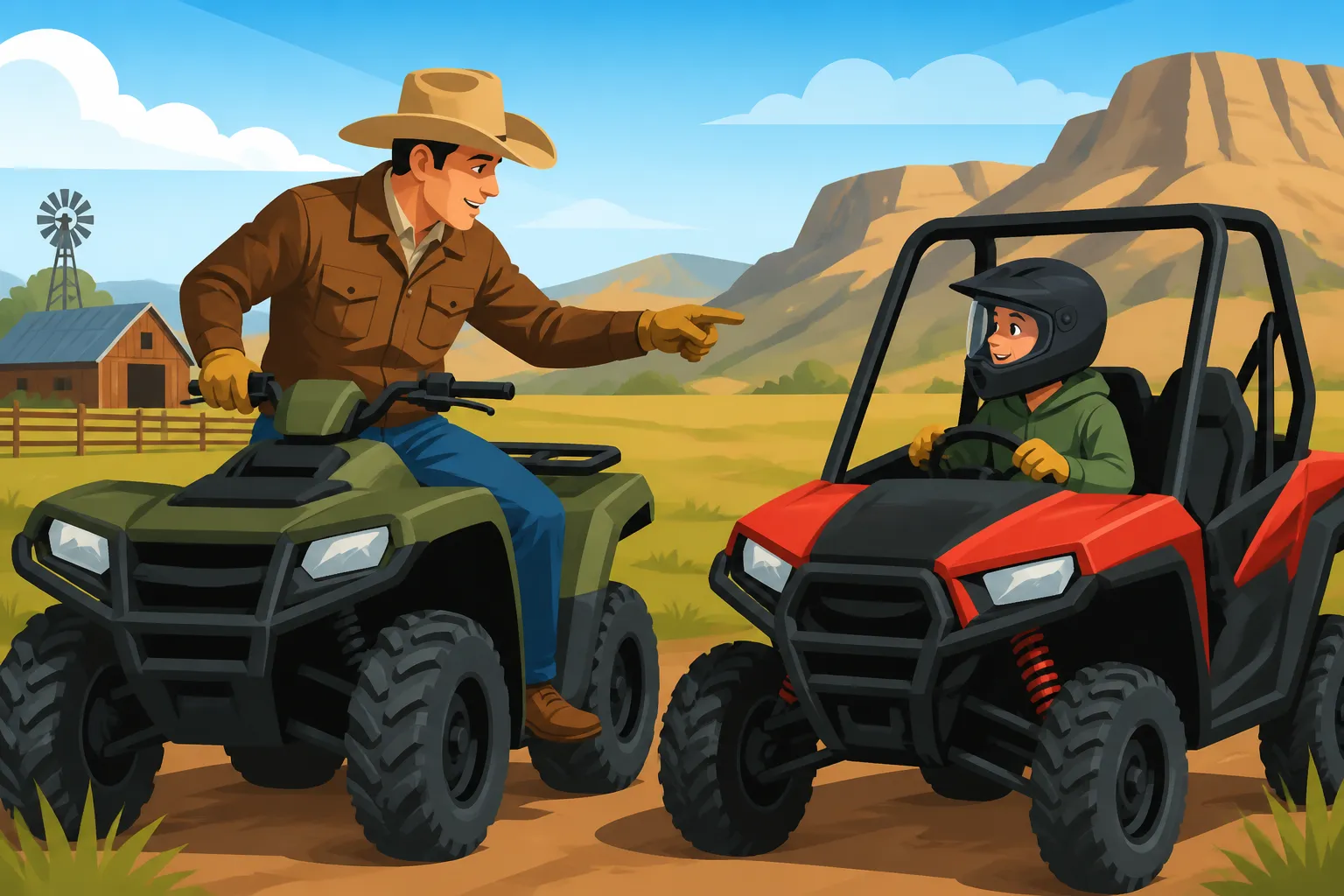
Choose a flat, open practice area with firm ground, good visibility, and no traffic, animals, ditches, ponds, fences, or obstacles in the riding line. Keep the first session short. A child who is tired, cold, frustrated, or distracted is more likely to make an avoidable mistake. One attentive adult should supervise directly rather than trying to watch multiple riders from a distance.
Before the machine moves, set simple rules: where to ride, how far to go, what signal means stop, and what to do if the adult is not visible. Explain that the child must not ride beyond the marked area, carry a passenger, race, perform stunts, or use the machine without permission. Have the child repeat the rules back. If they cannot explain the stop signal or boundary, they are not ready to begin.
A gradual first lesson might follow this sequence:
- Walk around the machine together. Identify the controls, the ignition or stop switch, brakes, and any safety features. Explain where to place hands and feet.
- Practice getting on and off. Keep the machine off while the child learns to mount and dismount without knocking the controls or losing balance.
- Demonstrate how to stop. Show how to bring the machine to a controlled stop, then let the child practice from a very short distance at low speed.
- Practice straight-line movement. Use a clear, short route and have the child stop at a marked point. Repeat until stopping is predictable.
- Add wide turns. Start with gentle turns at walking pace. Do not add tight turns, hills, or rough ground until the child can steer and stop reliably.
- Review each attempt. Give one clear correction at a time. End the session if the child is no longer following directions or controlling the machine consistently.
Avoid coaching from far away or giving several instructions at once. Short, direct cues are easier to understand while the child is concentrating on the controls. Praise safe decisions—such as slowing down before a turn or stopping when asked—rather than speed or distance. If the child is anxious, stop and reset instead of urging them to continue.
Keep the adult close enough to intervene, but do not ride alongside in a way that creates another collision risk. If another adult is present, assign one person to supervise the child and another to manage other activity on the ranch. Do not assume that a child who has ridden once can safely practice unsupervised later. Each session should begin with a check of the conditions, the machine, the protective gear, and the agreed boundary.
Terrain should become more challenging only when the child shows consistent control on easy ground. Small bumps, loose soil, slopes, and wet grass change how a machine brakes and turns. Teach one new condition at a time, at a slow pace, and return to flatter ground if the child struggles. Do not use a steep hill, creek bank, road shoulder, or obstacle course as a shortcut to “real experience.”
Know when the ride leaves ranch ground
The rules can change as soon as the child and machine leave private property. A public road crossing is not just another part of a ranch loop, and a designated public trail is not covered by permission to ride on the ranch. Plan a route that turns around before reaching a boundary unless the child and machine meet the requirements for the next area.
For a public trail, check whether it is open to the machine, whether a permit is required, and whether the child is allowed to ride there under the applicable rules. A machine that is permitted on the ranch may not meet public-road or trail requirements. Review South Dakota Rules for Riding a State Trail and South Dakota Rules for Crossing a Highway before adding either type of route to a child’s ride.
Public-road rules may include requirements related to age, licensing, equipment, or where the machine may travel. A child’s ability to operate safely on private ground does not by itself authorize road use. Likewise, seeing other riders use a ditch does not confirm that a child may ride there or that the route is open in that county. Check the relevant rules rather than using another rider’s behavior as a guide.
For the first lessons, it is usually simplest to keep the ride fully inside a clearly defined practice area. If the family later wants to use public land or trails, treat that as a separate step: confirm the access rules, machine requirements, permits, and age-related rules, and choose a route suited to the child’s skill. That separation makes it easier for a young rider to learn without confusing ranch permission with permission to ride everywhere.
A sensible ranch lesson is deliberately uneventful: a suitable machine, protective gear, clear boundaries, one supervising adult, and a short route the child can handle. Build up only after the child can follow instructions and control the machine reliably. Private land can offer room to practice, but safe access still depends on permission, preparation, and knowing when the ride has reached its limit.
Disclaimer
This article is for general informational purposes only and does not constitute professional advice. Laws, prices and regulations vary by location and change over time. Consult a qualified professional for guidance on your specific situation.