South Dakota Driver’s License Rules for ATVs
Navigating the rules for riding an ATV in South Dakota can feel like untangling a ball of yarn, especially when it comes to something as fundamental as whether you need a driver's license. Many riders assume that if they're on an ATV, a traditional driver's license isn't a factor, only to find out the hard way that South Dakota has some very specific nuances. This guide will walk you through South Dakota's driver's license requirements for ATVs and UTVs, helping you understand when you need one, when you don't, and what complications can arise if you're not prepared.
When Your ATV Meets South Dakota Roads: The Driver's License Question
It's easy to get confused when you think about driver's license requirements for ATVs. After all, they're not cars, right? The truth is, in South Dakota, whether you need a driver's license to operate your ATV or UTV often hinges on where you're riding and, crucially, whether your machine is plated for road use. This isn't just about common sense; it's about specific laws designed to keep everyone safe on shared roadways.
It's Not Always a Simple Yes or No
For many riders, the assumption is simple: if it's an off-road vehicle, you don't need a driver's license. While this holds true for most dedicated trails or private land, South Dakota throws a curveball when you want to take your machine onto public roads. The moment your wheels touch a county road or a state highway shoulder (where permitted), the conversation changes entirely. You're no longer just an off-road enthusiast; you're operating a motor vehicle in traffic, and that carries different responsibilities. For example, if you're riding with friends from out of state and they're used to different rules, this can be a major point of confusion. [South Dakota Rules for Riding a Gravel Road] are distinct from rules governing private trails.
The state differentiates significantly between riding strictly off-road—like on designated OHV parks or private property—and operating an ATV or UTV on public streets and highways. On your own ranch, or even on many public trails, a standard driver's license often isn't required for adults. The state focuses more on age restrictions for minors in these scenarios. However, the minute you plan to utilize public roadways, even for short stretches or crossings, that's when you really need to pay attention to your licensing status.
The Key is Often Your Plate and Vehicle Type
South Dakota has a fascinating approach to allowing ATVs and UTVs on public roads: it generally requires them to be licensed as motorcycles. This means your quad or side-by-side needs to meet certain criteria to get a motorcycle plate, and once it does, the rules shift. This isn't like just slapping a permit on it; it's a full-on titling and registration process that acknowledges your machine as a street-legal vehicle. Many riders overlook this crucial step, assuming a permit is enough for road travel.
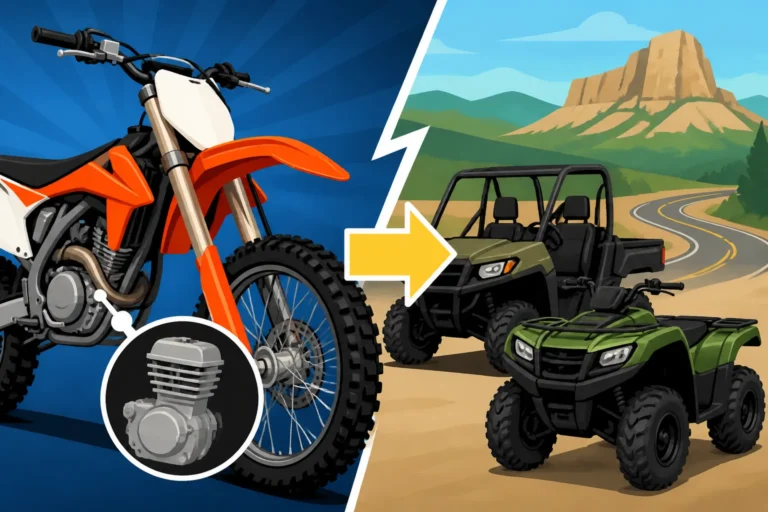
The state specifically outlines requirements for what it considers a "motorcycle" when it comes to engine size. For four-wheeled ATVs to be plated for road use, they generally need to have an engine displacement of 200cc or more. For two-wheeled dirt bikes, the threshold is 120cc. If your machine meets this engine size, along with other equipment requirements like mirrors, horns, headlights, and brake lights, you can apply for a motorcycle plate. Once plated, however, the driver's license requirement becomes less straightforward than you might think. [What South Dakota Requires to Plate an ATV] details all the necessary equipment.
Deeper Dive: South Dakota's Specific Plating and Licensing Rules
Understanding the intricacies of South Dakota's rules for plating and the resulting driver's license implications is crucial for any rider hoping to legally hit the road. It's not just about getting a plate; it's about understanding how that plate changes your legal obligations as an operator.
Engine Size and the Path to a Motorcycle Plate
As mentioned, South Dakota sets specific engine size minimums for ATVs and UTVs to be considered for road-legal registration as a motorcycle. This 200cc threshold for four-wheelers and 120cc for two-wheelers is fundamental. If your machine falls below these cubic centimeter limits, it simply cannot be plated for public road use in South Dakota, regardless of what modifications you make. This is a common point of frustration for owners of smaller youth machines or older, less powerful models who wish to use them for short hops on local roads.
Beyond engine size, your machine needs to be equipped with standard safety features. Think of it like getting your car ready for inspection: you need working headlights (both high and low beam), brake lights, a horn, and at least one rearview mirror. Some riders also consider adding turn signals and a windshield, even if not strictly mandated, for added safety and comfort, especially if using their machine for utility or touring on backroads. Accessories from companies like SuperATV can help outfit your machine with the necessary mirrors or lighting to meet these standards. Without these essential pieces of equipment, even a 200cc+ machine won't pass muster for a motorcycle plate. [South Dakota Equipment List for Road Use] provides a thorough checklist.
The Driver's License Exception for Plated Machines
Here's where it gets truly interesting and often catches people off guard. South Dakota offers a unique exception for operating a properly plated ATV or UTV on public roads. If your off-road vehicle has been successfully titled and registered with a South Dakota motorcycle plate, you do not necessarily need a standard driver's license (Class 1 or 2, for cars or motorcycles) to operate it on roads where ATVs are permitted. This is a significant departure from many other states where any vehicle on a public road demands a licensed driver.
This exception means that, theoretically, an adult (18 years or older) who does not hold a traditional driver's license could still legally operate a street-legal ATV in South Dakota, provided the machine is plated. However, there are some critical caveats. First, this exception primarily applies to adults. Second, while you might not need a driver's license in the traditional sense, you still must be at least 18 years old to operate a plated ATV on public roads. Third, this exemption doesn't grant you the right to drive other vehicles; it's specific to the plated ATV. If you're pulled over, a law enforcement officer will still verify your age and that the machine is indeed plated. [Riding a Plated ATV Without a Driver's License] explains more about this specific South Dakota rule.
Beyond the Pavement: Other Scenarios for ATV Riding
While the road rules are often the most complex, it's equally important to understand driver's license requirements when you're off the pavement, whether it's on your own land, designated trails, or as an out-of-state visitor.
Private Land and Controlled Off-Road Areas
When you're riding on private property with permission, or within designated off-road vehicle (ORV) parks like Oahe Downstream, the need for a driver's license largely disappears for adults. On private land, the landowner's rules generally apply, and state licensing requirements for public roads don't extend to your backyard or a friend's ranch. This is where most recreational riding happens without the overhead of licensing concerns. If you're on your family farm in eastern South Dakota, running fence lines or checking livestock with your UTV, a driver's license isn't a prerequisite.
For minors, however, even on private land or in ORV parks, supervision and age rules still apply. South Dakota has specific minimum age requirements for operating ATVs, especially on public lands or ditches where permitted. Generally, a rider must be at least 12 years old to operate an ATV in a ditch or on designated trails, often under the supervision of an adult. While a driver's license isn't a factor for them, knowing these age limits and supervision guidelines is vital for responsible riding. [South Dakota Minimum Age for Ditch Riding] gives more context on this.
What About Out-of-State Riders and Youth?
Visiting South Dakota with your ATV? The driver's license rules can get a bit murky. If your machine is legally street-legal and plated in your home state, South Dakota generally extends reciprocity for road use, meaning your out-of-state plate is honored. However, this relies on your home state's vehicle and licensing laws aligning, and you must adhere to South Dakota's rules regarding operation on its roads (e.g., speed limits, ditch riding regulations, etc.). This doesn't mean you can ignore South Dakota's driver's license exception; if your home state requires a driver's license for your plated ATV on public roads, you should still possess it.
For non-residents planning to ride solely on trails or off-road areas, the driver's license question is less about your personal license and more about the machine's permit. If you're using Black Hills National Forest trails, for instance, your machine will need a [Black Hills Motorized Trail Permit Cost], regardless of where you're from. Your driver's license is generally not checked for trail access, but local law enforcement may still ask for identification if there's an incident or a stop.
| Scenario | Driver's License Required (18+ yrs) | Machine Needs South Dakota Motorcycle Plate | Other Key Considerations |
|---|---|---|---|
| Public Road / Ditch Riding | No (if plated) | Yes (200cc+ ATV, 120cc+ Dirt Bike) | Must be 18+, machine equipped (horn, mirror, lights) |
| Designated OHV Park / Trail | No | No (but may need a Trail Permit) | Age restrictions for minors, often supervised |
| Private Property (with perm.) | No | No | Landowner rules apply, age restrictions for minors |
| Crossing a Highway | No (if plated) | Yes | Must be 18+, obey traffic laws, direct crossing only |
| Out-of-State Plated Machine | Varies by home state | No (home state plate honored) | Adhere to SD road rules; reciprocity applies |
Understanding the Stakes: Penalties for Non-Compliance
Ignorance of the law is never an excuse, and when it comes to ATV regulations in South Dakota, failing to adhere to licensing and plating rules can lead to significant consequences. It's not just about a simple ticket; depending on the violation, you could be facing more serious legal ramifications.
When a Class 2 Misdemeanor Applies
Riding a machine on public roads that should be plated but isn't, or operating it without adhering to the age requirements, can put you in hot water. Specifically, operating an off-road vehicle on a public roadway (not within approved ditch riding areas or designated crossings) without it being properly plated as a motorcycle can result in a Class 2 Misdemeanor. This isn't a parking ticket. A Class 2 Misdemeanor in South Dakota carries potential penalties that can include jail time (up to 30 days), a substantial fine, or both. It also creates a criminal record, which can impact various aspects of your life, from employment to insurance. [What a Class 2 Misdemeanor Costs a Rider] illustrates the severity of these penalties.
Imagine you're on a trip to the Black Hills, you decide to take a shortcut on a county road, and your ATV isn't plated. A local sheriff's deputy spots you. What started as a harmless detour could quickly escalate into a legal headache, requiring court appearances and potentially derailing your vacation. This is why it's always critical to know the precise status of your machine and your own eligibility before venturing onto any public thoroughfare.
The Importance of Knowing the Rules Before You Ride
The best defense against penalties is knowledge and proactive compliance. Before you even load your ATV onto a trailer or pull out of your driveway, take the time to understand where you're going and what the specific rules are for that area. If you plan to use any public roads, no matter how short the distance, confirm your machine is properly titled and plated as a motorcycle in South Dakota, and that you meet the age requirements. If you're from out of state, ensure your machine's registration is valid and that you're aware of South Dakota's specific operational laws.
It might seem like a lot of hoops to jump through, but these regulations are in place for a reason: safety. They help to manage the interaction between off-road vehicles and traditional traffic, ensuring that everyone on the road understands the rules of engagement. Equipping your UTV with appropriate safety gear from reputable brands like SuperATV is always a smart choice, even if not strictly mandated for every riding scenario. Ultimately, being a responsible rider means being an informed rider, and that starts with knowing South Dakota's driver's license rules for ATVs.
Disclaimer
This article is for general informational purposes only and does not constitute professional advice. Laws, prices and regulations vary by location and change over time. Consult a qualified professional for guidance on your specific situation.