Why South Dakota Has No Safety Certificate
South Dakota does not require every ATV or UTV rider to carry a state safety certificate. That can be confusing if you are visiting from somewhere that does, or if you are planning a ride with a child. The key is to separate the absence of a universal course requirement from the age, access, permit and equipment rules that still apply.
What “No Safety Certificate” Means
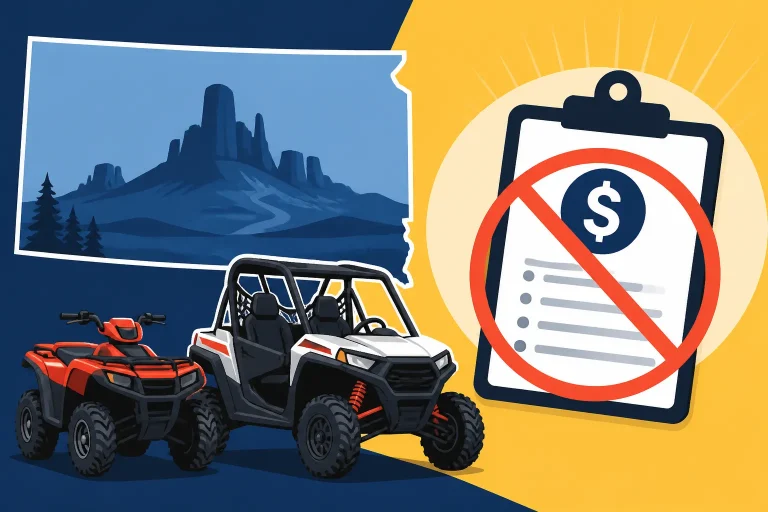
South Dakota does not make a state-issued ATV or UTV safety certificate a universal prerequisite for riding. In other words, a rider generally does not need to complete a state-mandated course and carry proof of completion simply to operate an off-road machine in the state.
That does not mean safety training is pointless, or that every rider can operate everywhere without restrictions. It means the certificate itself is not the general statewide gatekeeper. A rider may still need to meet rules tied to age, location, vehicle use, permits or a rental agreement.
It also helps to distinguish a safety certificate from other documents:
| Document or requirement | What it does | Is it the same as a safety certificate? |
|---|---|---|
| ATV safety course card | Shows that a rider completed a course | Yes, this is the kind of proof South Dakota does not universally require |
| Trail or ORV permit | Authorizes particular use where a permit is required | No |
| Vehicle title or registration | Identifies ownership or road-use status | No |
| Driver’s license | May be relevant to particular road-use situations | No |
| Rental agreement or briefing | Sets the rental company’s conditions and explains its machine | No |
The state’s approach should not be read as a recommendation to ride without instruction. ATVs and UTVs can roll, lose traction, or behave differently on steep, loose or uneven ground than they do on a flat road. A basic course can help riders understand weight transfer, braking, passenger safety and how to respond to a stuck or overturned machine. It can be especially useful for someone new to off-road riding, even when the state does not require a certificate.
For a fuller look at the statewide rule and what it does—and does not—cover, see Does South Dakota Require an ATV Safety Course? and South Dakota ATV Safety Course Requirements.
What Riders Still Need to Check
A missing certificate requirement does not cancel other rules. Before riding, identify the machine, the place you intend to ride and the kind of use you have planned. A rule that applies to riding in a public right of way may not be the same as one that applies on private land, a designated trail or federal ground.
Age and supervision
A rider’s age can matter even though there is no universal safety-card requirement. Restrictions may depend on the type of riding and where it takes place. Do not assume that a child who can safely operate a machine is automatically allowed to ride every public route, or that adult supervision makes every restriction disappear.
Check South Dakota Minimum Age to Ride Public Land and South Dakota Supervision Rules for Young Riders when planning a ride with a minor. Treat those rules as separate from course completion: a training card does not replace an age or supervision requirement, and a lack of a course requirement does not remove one.
For children, the practical decision should also account for the machine’s size and controls. A young rider needs to be able to reach and use the controls, understand how to stop, and follow instructions without distraction. A passenger should not be added unless the machine is designed for one and the rider can control it safely with that passenger aboard.
Where you ride
Permission to ride in South Dakota is location-specific. A route may be on private property, a public road right of way, a state-managed riding area or federal land, and each can have its own access rules. A safety certificate does not grant land access. Likewise, a permit or plate does not by itself mean that a route is open to your machine.
On private property, get the landowner’s permission and follow any conditions they set. On public land, check the managing agency’s current rules and route information before unloading. For federal land, start with South Dakota Rules for Riding Federal Land rather than assuming that a rule from another riding area applies.
Permits and vehicle status
Permits are not substitutes for safety training, and a training certificate is not a substitute for a permit. South Dakota’s motorized trail permit and its nonresident ORV permit address access and use, not a rider’s training history. Requirements can depend on the machine, its registration status, whether the rider is a resident and where it will be operated.
Read South Dakota’s Motorized Trail Permit and South Dakota Nonresident ORV Permit Requirements before a trip. Out-of-state owners should separately check how South Dakota treats their machine’s registration; do not assume that a safety card or home-state document covers every South Dakota permit obligation. Does South Dakota Honor Out-of-State Registration? explains why those are separate questions.
Road use is different from trail riding
A machine used on a road may be subject to requirements that do not apply in the same way on a designated off-road route. Road use can raise questions about whether the vehicle may be plated, what equipment it needs and whether the operator must hold a particular license. A safety-course card does not make an off-road machine road legal.
Before riding along or crossing a public road, check the rules for that specific use. Avoid treating a trail permit as permission to travel on any road, or a road plate as permission to use every trail.
Visitors, Rentals and Other Safety Rules
Visitors sometimes assume that a certificate required at home will automatically be demanded in South Dakota, or that it will stand in for every local requirement. Those are different issues. South Dakota’s general absence of a certificate requirement does not mean a visitor can ignore rules from their home jurisdiction that may apply to them. It also does not establish that a home-state card satisfies South Dakota’s permit, vehicle or land-access rules.
The practical approach is to check three things independently:
- Your rider obligations: Confirm whether age, supervision, license or other operator rules apply to the ride you are planning.
- Your machine obligations: Check whether the machine needs a permit, plate or other documentation for the place you intend to use it.
- The land manager’s rules: Confirm that the specific area and route are open to your machine and that you have any required authorization.
A rental company may also impose conditions that go beyond the state’s general certificate rules. It could require a minimum age, a valid driver’s license for particular rentals, a safety briefing, signed paperwork or limits on who may operate the machine. Those are rental terms, not evidence that South Dakota has a universal state certificate requirement. Read the contract and ask the company which riders are permitted to drive. For more on the distinction, see South Dakota Rules for a Rented Machine.
A rental briefing can be valuable, but it is not necessarily a formal safety course or a certificate. Ask what the briefing covers: controls, passenger limits, route boundaries, stopping distance, emergency contacts and what to do if the vehicle becomes disabled. If the explanation is rushed or the rider is unfamiliar with the machine, pause and ask questions before leaving.
For your own safety, training is worth considering even when it is optional. A useful course should teach more than how to start and steer. Look for practical instruction on protective gear, passenger safety, terrain assessment, braking, turning, hill travel, avoiding rollover situations and what to do after a breakdown. A certificate may be useful for personal records or for meeting another jurisdiction’s conditions, but do not assume that it grants access or overrides South Dakota rules.
A Practical Pre-Ride Check
Before setting out, use this checklist to avoid confusing “no certificate required” with “no rules apply”:
- Identify the machine and its use. An ATV, side-by-side and road-oriented vehicle may not be treated alike for every purpose. Decide whether the ride is off-road, on a permitted trail, on private land or partly on a public road.
- Confirm who may operate it. Check age and supervision rules for the planned location. If a minor is riding, make sure the machine fits their ability, not just their height.
- Check access and permits. Verify the current requirement for the specific land and route. Keep any required permit or registration information available as directed.
- Ask about rental conditions. If the machine is rented, confirm the minimum age, permitted operators, briefing requirements, passenger rules and allowed riding areas before signing.
- Choose protective equipment. Use a properly fitted helmet and suitable eye protection, and wear clothing that protects against abrasion, weather and debris. A certificate does not replace protective gear.
- Match the route to the rider. Start with terrain and distances the least experienced person in the group can handle. Keep the group together and agree on what to do if someone falls behind.
- Check current closures and notices. Access can change because of conditions or land-management decisions. A route that was open on a prior visit may not be open for the next one.
The short answer is simple: South Dakota does not impose a universal ATV safety certificate requirement, but that is only one part of the riding rules. Age, supervision, permits, vehicle status, rental conditions and land access still need separate attention. If you are uncertain about a specific ride, confirm the current requirements with the relevant agency, land manager or rental provider before you go.
Disclaimer
This article is for general informational purposes only and does not constitute professional advice. Laws, prices and regulations vary by location and change over time. Consult a qualified professional for guidance on your specific situation.