Packing a Deer Out of a Hills Draw
A deer down in a Black Hills draw can be difficult to reach on foot, but an ATV or UTV is not a shortcut to unrestricted access. The safe plan is to check the hunting and travel rules first, stay on routes open to your machine, and carry the animal without making the ride unstable.
Check whether the machine can reach the recovery area
Before riding toward a deer, separate two questions: whether you may hunt and retrieve game there, and whether you may drive a motor vehicle to that location. A hunting license or permission to hunt does not automatically grant motorized access. Likewise, a trail permit does not authorize riding off a designated route to reach an animal.
Start with the exact land parcel and route, not just the nearest trailhead or road. In the Black Hills, a draw might sit beside a Forest Service road, a designated motorized trail, private land, a grazing lease, or a wildlife area. Rules can differ across a short distance, and a route that looks rideable may be closed to your machine or seasonally restricted. Use current maps and closure notices, and ask the land manager if the boundary or route status is unclear.
If you are hunting on private ground, get permission for the planned access and recovery route, not only permission to hunt. On public ground, check the specific area’s hunting rules and motorized-use map. The restrictions discussed in South Dakota Rules for Retrieving Game by ATV should be checked against current rules before a trip. Also review South Dakota Rules for Riding Off a Route: an animal’s location does not by itself make off-route travel legal.
| Question | What to verify before riding |
|---|---|
| Where is the animal? | Identify the land parcel, boundary, and likely approach route |
| Is motorized travel allowed? | Confirm the route is open to your vehicle type and width |
| Is recovery allowed by machine? | Check current hunting and land-manager rules for that area |
| Is a permit needed? | Check whether the road or trail requires a plate, permit, or both |
| Can the machine carry the load? | Check the manual’s payload limit and plan for the combined weight |
| Can the route be ridden safely? | Consider slope, loose rock, mud, visibility, weather, and daylight |
For federal land, confirm the route designation and current restrictions with the land manager. South Dakota Rules for Riding Federal Land offers another useful starting point, but a general overview is not a substitute for the map and notices that apply to the particular road or trail. The same caution applies to wildlife areas; review South Dakota Rules for Riding a Wildlife Area before entering one.
A permit covers only what it covers. A trail permit may be required on a designated motorized trail, while a road may have separate requirements. Why a Road Needs a Plate or a Permit explains why these permissions should not be treated as interchangeable. If the planned route crosses private property or a grazing lease, sort out access with the landowner or leaseholder in advance; South Dakota Landowner Permission Rules is relevant to that part of the plan.
Plan the recovery route before the shot
A route that is manageable while the machine is empty may become much harder with a deer aboard. Draws can have steep sides, loose rock, tight turns, deadfall, and poor sightlines. Walk or inspect the route when practical, and choose a legal way in and out that avoids unnecessary climbs and sharp side slopes.
Mark the intended route on a current map and identify a turnaround point. Do not assume that a track visible on a phone map is an open motorized route. Check South Dakota Trail Closures to Check and carry an up-to-date map as a backup. The habit described in Carrying the Black Hills Travel Map on Every Ride is especially useful when service is weak or a closure changes the route.
Before leaving, tell someone where you are going and when you expect to return. Bring a charged phone, a way to navigate without cell coverage, water, basic tools, and recovery equipment suitable for your machine. Consider the conditions as well as the distance: rain can turn a firm two-track into a slippery route, and fading light makes it harder to spot ruts, rocks, and other riders.
Use this simple sequence to reduce surprises:
- Pin the recovery location and confirm which land manager controls it.
- Check current hunting rules, access permissions, route maps, and closures.
- Confirm the machine is allowed on each road or trail you plan to use.
- Estimate the load, including rider, passenger, gear, and deer, against the machine’s rated capacity.
- Choose a route that avoids steep side slopes and offers a safe place to turn around.
- Tell someone your route and return plan; carry the map and essentials you need if the machine cannot continue.
- Recheck conditions at the trailhead. If the route or weather is worse than expected, change the plan.
A route may be legal but still be a poor choice. If the draw is too steep, the ground is slick, or the machine would have to cross a closed route, do not force the recovery with a vehicle. A hand carry, a different legal approach, or help from another person may be safer. Do not damage vegetation, create a new track, or block a road while trying to make a short recovery easier.
Load the deer without making the machine unstable
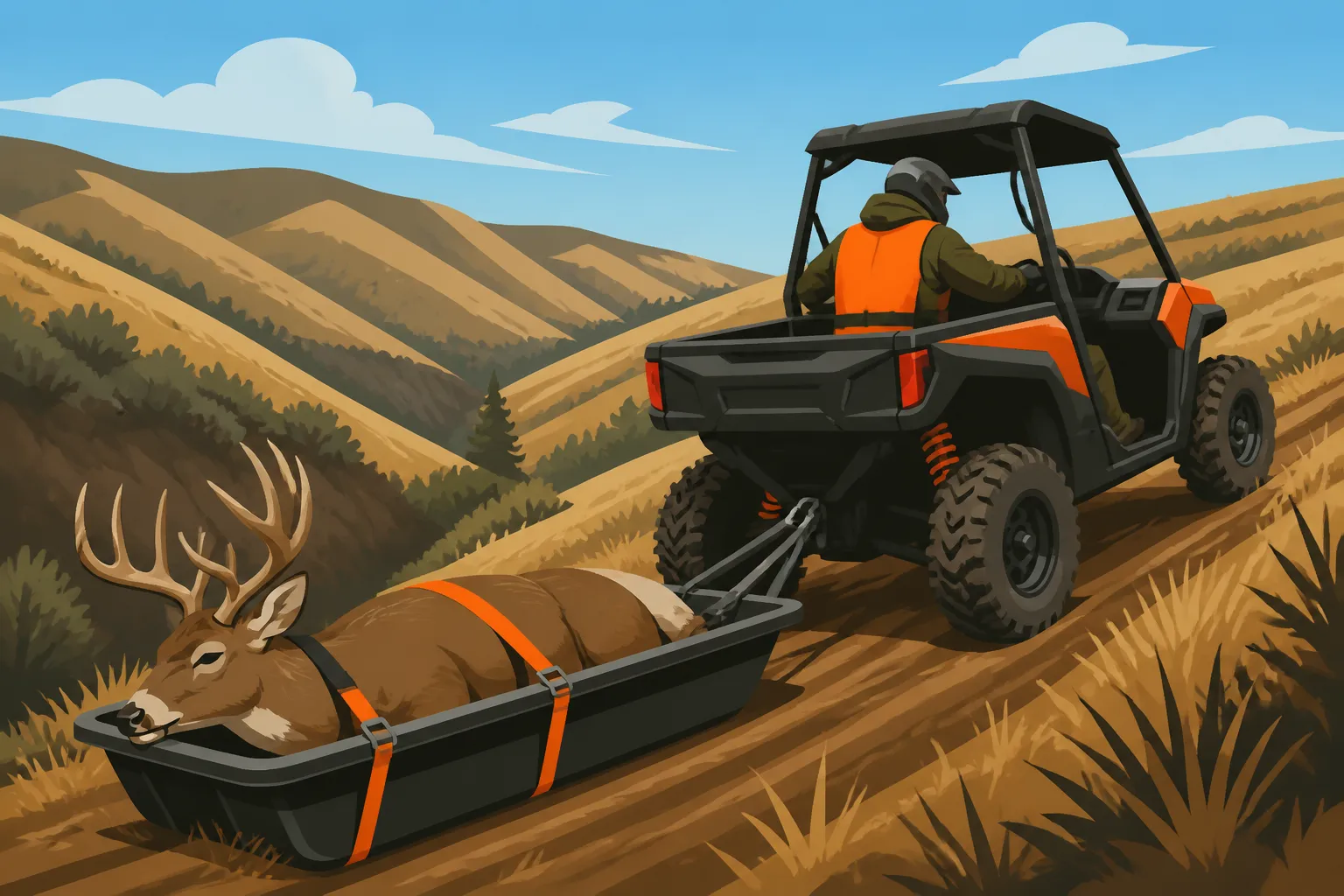
Know the payload limit in the owner’s manual before relying on the machine to carry a deer. Payload includes the rider, passenger, equipment, and cargo; it is not simply the weight of the animal. A large deer can use more of that capacity than expected, and uneven ground can make a load feel less manageable than it does on level ground.
Field dress and prepare the deer according to the applicable hunting requirements and your safe-handling practices. Keep meat clean and protected from dirt, exhaust, fuel, and hot machine parts. Use game bags or other clean coverings suited to the job. Straps should be in good condition and secured to appropriate cargo points, not controls, suspension parts, or places where they could contact a wheel, belt, exhaust, or moving component. If buying straps, bags, or other recovery supplies, compare size and load ratings from outdoor retailers or Amazon and check that the gear fits the machine and intended use.
Keep the load low and centered as much as possible. A load hanging far off one side can pull the vehicle toward the slope, while a high load can raise the center of gravity and make turns less stable. Do not let a carcass drag where it can snag, catch on brush, or shift suddenly. Check that the load cannot slide backward or interfere with the operator’s ability to steer, brake, or see.
A second rider can help with loading, but adding a passenger also reduces the machine’s remaining payload capacity. If the load cannot be secured without blocking the operator or exceeding the machine’s rating, make another trip or use a different lawful recovery method. Do not stack extra gear on top of a deer just because the rack still has room.
Before moving, check every strap and walk around the machine. Make sure nothing can reach the tires or hot parts, the cargo is not obstructing lights or controls, and the animal is not likely to shift on a sidehill. Ride slowly, avoid abrupt steering and braking, and leave extra room for turns. A machine carrying a heavy or off-center load may respond differently from an empty one.
Keep firearms unloaded and secured in accordance with applicable law and safe transport practices. Keep knives and other tools secured as well. Do not let loose equipment move around in the cargo area; an item that shifts on a rough descent can distract the operator or affect balance.
Ride out cautiously and finish the job
Take the easiest legal route, even if it adds distance. Avoid sharp side slopes, sudden stops, and fast descents. Where the track is narrow or visibility is limited, proceed slowly and use a spotter on foot only when the person can stand in a safe location away from the machine’s path. Agree on signals before moving and never ask a spotter to stand below a machine on a steep slope.
Stop on level ground to recheck the load after the first rough section and again if it shifts. If a strap loosens, park safely before adjusting it. Do not try to hold a shifting load by hand while the machine is moving. If the ground or route becomes unsafe, turn back if that can be done safely or arrange another lawful way to remove the animal.
Mud, snow, and low temperatures can change traction and handling. A loaded machine may be difficult to stop, and a wheel spinning in a draw can worsen erosion or leave the vehicle stuck. Avoid forcing a climb with a heavy load. If recovery gear is needed, use it only from approved attachment points and follow the machine manufacturer’s instructions.
At the trailhead or road, make sure the animal is secured for the next leg of travel and that your route remains legal. A public-road connection can have different requirements from the trail where you began. Do not assume a trail permit is a substitute for a plate or other road permission. If the vehicle must travel on a road, verify the applicable requirements before heading out.
Finally, report any route damage, hazard, or closure issue through the appropriate land manager’s process. Pack out straps, packaging, and other supplies. Good route choices protect access for other hunters and riders, while a hurried recovery that leaves a new track or damaged ground can affect future use.
The safest recovery is one planned around both access rules and the machine’s limits. If you cannot confirm that the route is open, or cannot carry the deer securely within the vehicle’s capacity, leave the ATV or UTV out of the draw and use another method.
Disclaimer
This article is for general informational purposes only and does not constitute professional advice. Laws, prices and regulations vary by location and change over time. Consult a qualified professional for guidance on your specific situation.