South Dakota Rules for Riding a Corps of Engineers Area
A lake shoreline or campground road can look like an easy place to take an ATV or UTV, but Corps of Engineers property is not automatically open to off-road riding. The key is to know whether your route is an authorized road or designated riding area, what rules apply to your machine, and whether a permit is required. Here’s how to check before you unload.
Start with the land boundary and the route
“Corps of Engineers area” can mean a large federal water project, not one continuous recreation area with a single set of riding rules. Around a reservoir, land may be managed by the U.S. Army Corps of Engineers, the state, a local government, or a private owner. Those boundaries can sit close together, and a road or trail that crosses one parcel may enter another.
The first question is not whether you have a plate or permit. It is whether the specific road or area is open to your kind of vehicle. Federal project rules generally restrict motor vehicles to roads and areas authorized for vehicle use. A shoreline, field, beach, boat ramp, campground loop, or service track is not an ATV route just because it is reachable from a public road.
Before riding, identify:
- The managing agency for the exact place you plan to use.
- The road, trail, or riding area that is open to motor vehicles.
- Whether the route allows ATVs, UTVs, or only ordinary highway vehicles.
- Any posted seasonal closure, gate, or vehicle restriction.
- Where the route ends and what land lies beyond it.
Use current signs and the managing agency’s maps or recreation information. A trail shown on an old map, a route visible in an aerial image, or tire tracks on the ground do not prove that riding is allowed. When a boundary or route is unclear, stop and ask the project office or site manager rather than guessing.
The distinction between a road and off-road travel matters. A road may be open for access to a boat launch or campground but not for leaving the road to ride across adjoining ground. Parking at a recreation site also does not create permission to ride nearby. Stay on the authorized route, obey barriers, and do not bypass a closed section by cutting across grass or shoreline.
This is different from riding in areas managed specifically for motorized recreation. For a broader overview of how land management affects access, see South Dakota Rules for Riding Federal Land. The rules for a National Forest, state recreation area, and Corps project should not be treated as interchangeable.
Separate land access from vehicle permits and plates
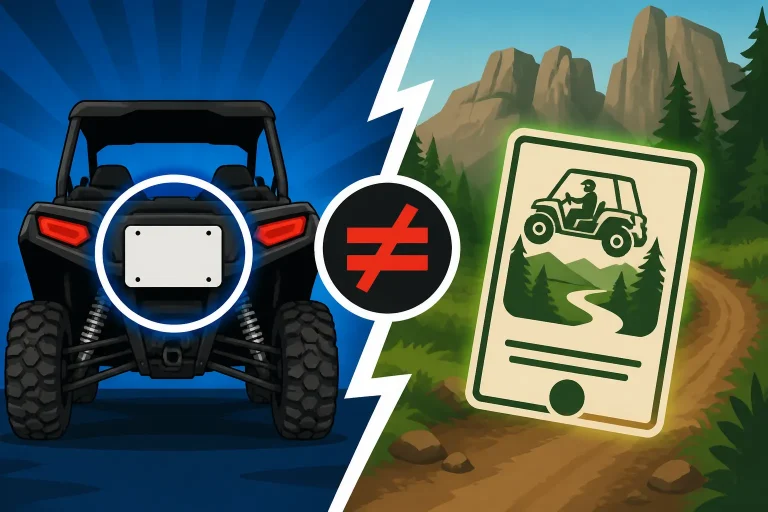
A plate, registration, permit, or decal answers a different question from land access. It may help establish that the machine meets a requirement for a particular kind of riding, but it does not give you permission to enter land or use a closed road.
| What you need to check | What it tells you | What it does not tell you |
|---|---|---|
| Corps or site rules | Whether the route or area is open to your vehicle | Whether your machine is properly titled or plated |
| Vehicle plate or registration | Whether the machine meets applicable vehicle requirements | Whether a Corps road is open to riding |
| Trail permit | Whether a permit is required for a particular trail system | Whether the permit applies to every federal property |
| Posted signs and closures | Whether access is restricted at that location or time | Whether nearby land has the same rules |
| Permission from a land manager | Whether you may use the specified property or route | Whether you can ride beyond the permission’s limits |
South Dakota’s motorized trail permit is associated with designated trail riding, including the Black Hills motorized trail system. It should not be assumed to function as a general pass for every federal property in the state. Before relying on a decal, confirm whether the specific Corps site requires it, whether it applies to the route you intend to ride, and whether a separate site rule controls. South Dakota Trail Permits Explained provides more context on what a state trail permit is for.
Likewise, an out-of-state plate does not turn restricted land into an open riding area. If a route is open to public road traffic, the machine still needs to satisfy the applicable road-use rules. If the route is closed to ATVs and UTVs, a plate from South Dakota or another state does not override the closure. For visitors, Does South Dakota Honor Out-of-State Registration? can help with the separate question of how the state treats a machine registered elsewhere.
The same distinction applies to an unplated machine. Some designated off-road areas may have different requirements from public roads, while other routes may require a plate or may be closed to ATVs altogether. Do not assume that a machine can use a Corps road simply because it is used off-road elsewhere. Check the site’s rules and the vehicle requirements for the route. If the machine has no plate, South Dakota Rules for a Machine With No Plate is a useful related reference.
When checking requirements, be specific. Ask about the exact recreation area and route, not just whether “ATVs are allowed at the lake.” A project may have many access points, roads, campgrounds, and adjacent jurisdictions, with different rules in each.
Check the rules for the particular Corps project
South Dakota has several large reservoirs and recreation areas associated with Corps projects. The name of a reservoir alone is not enough to establish where riding is allowed. Rules can differ between project lands, nearby state-managed areas, public roads, and private property. Even within a single project, a road open to passenger vehicles may not be open to off-highway use.
Use this practical check before planning a ride:
- Pin down the location. Record the recreation area, access point, road name or number, and the intended destination. “Near the reservoir” is too broad for a reliable answer.
- Identify the land manager. Look for the managing agency on signs, maps, or official recreation information. If agencies meet nearby, check the boundary rather than assuming.
- Confirm that ATVs or UTVs are allowed on the route. Ask whether the route is authorized for your specific type of machine, not merely open to motor vehicles generally.
- Check current restrictions. Confirm gates, temporary closures, construction, fire restrictions, seasonal conditions, and any local rule that may affect access.
- Ask about permit and plate requirements separately. A land manager can clarify access; state and local authorities may be needed for vehicle titling, plates, or public-road use.
- Follow posted instructions at the site. If a sign or barrier conflicts with an older map or a general answer, do not ride past it until you get clarification.
If you are near Oahe Downstream, distinguish a designated riding area from surrounding Corps project land. Oahe Downstream OHV Area in South Dakota covers the riding area, but its existence does not automatically make nearby shoreline, campground roads, or other federal parcels open to off-road travel. Confirm the boundary and rules for the particular place you are entering.
Land can also change managers across a short distance. A route may leave Corps property and enter land managed by South Dakota Game, Fish and Parks, a municipality, a county, or a private owner. Each manager can impose its own access rules. For a designated state area, consult South Dakota Rules for Riding GFP Land rather than carrying over the assumptions you made about Corps land.
Private parcels are another common boundary issue. A road that appears to continue past public land may enter a ranch or other private property. A public access point does not grant permission to cross private ground. If your intended route includes private land, get permission from the owner and keep within the agreed route. See South Dakota Landowner Permission Requirements for more on that separate requirement.
Public-road use, riding conduct, and common mistakes
An authorized Corps road is not necessarily a special ATV trail. It may be an ordinary public or project road with its own traffic rules, speed restrictions, and vehicle limits. Before using it, find out whether the machine must be plated, insured, or equipped for road use. A machine that is legal for an off-road riding area may not be legal on a public road.
If a route connects to a highway, do not assume you may ride along the shoulder or ditch to reach it. Roadside riding and highway crossings have their own rules, which are separate from Corps land access. Check South Dakota Rules for Crossing a Highway before planning a route that joins or crosses a road.
At the site, ride only where authorized and follow signs, gates, and directions from staff. Avoid sensitive ground, vegetation, beaches, and shoreline areas unless the managing agency specifically identifies them as open to vehicle use. Do not ride around a barrier, make a new trail, or use a closed road as a shortcut. These choices can damage public land and may lead to a citation or loss of access for other riders.
Common mistakes include:
- Treating all land around one reservoir as if it has the same manager.
- Assuming an open campground road is also open to ATV or UTV traffic.
- Relying on a trail permit as permission to ride anywhere on federal land.
- Using an out-of-state plate as proof that every route is open.
- Following tracks or an online map without checking current signs.
- Assuming a boat launch, parking area, or shoreline is a riding area.
- Continuing onto private land because a route appears to lead somewhere useful.
If the site information is unclear, contact the land manager before arriving with your machine. Ask whether your exact vehicle type may use the route, whether any permit is required, and where the authorized route begins and ends. Keep a note of the answer and follow the on-site signs when you arrive.
The safest rule is simple: treat access as location-specific. A permit does not open a closed route, a plate does not grant land access, and permission at one recreation area does not transfer to the next parcel. Confirm the manager, route, and requirements for the exact Corps area you plan to visit before riding.
Disclaimer
This article is for general informational purposes only and does not constitute professional advice. Laws, prices and regulations vary by location and change over time. Consult a qualified professional for guidance on your specific situation.