Teaching a Young Rider in South Dakota
Teaching a Young Rider in South Dakota
Teaching a child to ride an ATV or UTV is not just a matter of showing them the controls. The machine, rider’s age, practice area, supervision, and local rules all affect whether a first ride is sensible and allowed. This guide explains how to build skills gradually and what to check before taking a young rider onto South Dakota land or roads.
Start With the Rules for the Place You Plan to Ride
South Dakota does not have one simple age rule that answers whether a child can ride every kind of off-road vehicle everywhere. The answer can depend on whether the machine is on private property, a public right-of-way, a designated trail, or a road. Before teaching a young rider, identify the exact place you intend to use and check the rules that apply there.
The distinction matters because permission to ride on a family’s land does not automatically authorize riding on a public route. A child who can safely practice in a private field may still be too young for a particular public right-of-way or trail. The South Dakota Minimum Age to Ride Public Land and South Dakota Supervision Rules for Young Riders are useful starting points for sorting out the public-land questions.
Age 12 is a key threshold in South Dakota’s rules for riding in a highway ditch or right-of-way. Do not assume that an adult riding nearby makes every under-age situation legal. Check the current rule and any supervision exception before taking a child into a ditch. Also remember that the legal age threshold is not a recommendation that a child is automatically ready to ride there. Traffic, uneven ground, culverts, and limited sightlines make a roadside environment a poor place for early lessons.
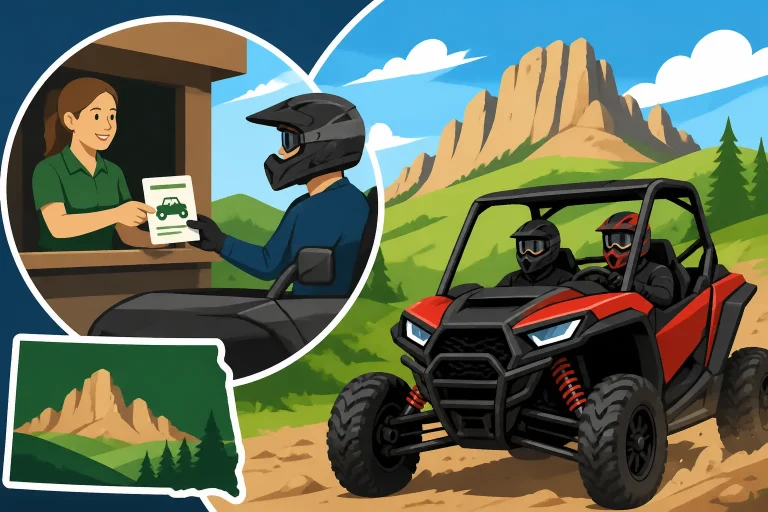
A public trail has its own requirements. In the Black Hills, for example, a motorized trail permit may be required for the machine using the trail. A permit is generally tied to the machine, not to the rider, so an adult’s decal should not be treated as covering a child’s separate machine. Check South Dakota Trail Permits Explained and the rules for the specific land manager before setting out. A permit also does not override age restrictions, route closures, or other operating rules.
Use this quick comparison to decide what to verify:
| Where the child will ride | What to check before the lesson |
|---|---|
| Private property | Permission from the landowner, hazards, boundaries, and whether the machine is suited to the rider |
| Public trail | Minimum-age and supervision rules, trail access, permit requirements, machine-width limits, and current closures |
| Highway ditch or right-of-way | The age threshold, any supervision rules, county restrictions, and rules for crossings |
| Public road | Whether that machine can legally use that road, required equipment, licensing, and any local restrictions |
| Rental machine or guided ride | The provider’s minimum-age and operator rules, insurance or waiver terms, included gear, and route limits |
A child’s age, experience, and size are separate considerations. A young rider may be old enough to operate a machine in one setting but not meet the rules for another setting. Likewise, meeting a minimum age does not mean the rider has the judgment or coordination for a fast, steep, or crowded route.
South Dakota’s ditch-riding rules also vary from general trail riding rules. Some counties may opt out of ditch riding, and a road crossing is not the same as traveling along a ditch. Check South Dakota Ditch Riding Rules Explained and South Dakota Counties That Ban Ditch Riding if a roadside route is part of your plan. Do not use the ditch as a training area simply because it looks open or quiet.
Finally, a safety course and a legal minimum age are different issues. South Dakota does not generally require an ATV safety certificate as a condition for every ride, but that does not mean instruction is unnecessary. Check Does South Dakota Require an ATV Safety Course? for the course requirement question, then make your own plan for teaching control, judgment, and safe habits.
Choose a Machine the Child Can Actually Control
The right machine is not simply the smallest one available or the one a child is eager to try. It should fit the rider physically and respond predictably at the speed and terrain appropriate for instruction. A machine that is too large, heavy, fast, or difficult to steer can turn a manageable mistake into a serious crash.
For an ATV, the rider should be able to reach the controls comfortably, operate the throttle and brakes without stretching, and shift their body position without losing control. Their hands should fit the grips and levers. Their feet should reach the footrests, and they should be able to stand or shift weight when the machine’s design calls for it. They should also be able to understand and use the stop control.
For a UTV, consider more than whether the child can sit in the seat. The operator must be able to reach and use the controls consistently, see the route, understand steering and braking, and stay properly seated with the restraint system in use. A passenger may have a different role, but sitting in the passenger seat does not make a child an operator. Do not let a child take the wheel unless the vehicle, setting, and applicable rules allow it and the child is ready for that responsibility.
Manufacturer guidance is an important starting point. Check the operator’s manual for the machine’s intended age range, operating limits, safety instructions, and any speed-limiting features. Treat these as minimum screening information, not proof that a particular child is ready. If the child cannot comfortably reach the controls or follow instructions under light pressure, choose a different machine or wait.
Size alone is not a reliable guide. A small child may be physically strong but lack the judgment to manage speed or a sudden obstacle. An older child may be cautious and coordinated yet still struggle with a heavy machine. Watch how the rider handles a stationary machine and simple, low-speed exercises before progressing.
An ATV is generally for one rider unless the manufacturer specifically designed it for more. Do not carry a child as a passenger on a single-rider ATV. A passenger can shift the machine’s balance and interfere with the operator’s movements. For a UTV designed to carry passengers, use the proper seat belts and other restraints, keep every occupant inside the protective structure, and follow the manufacturer’s instructions. Avoid letting a child ride unrestrained in a cargo area.
Before the first engine-on lesson, check the machine:
- Inspect the tires, brakes, throttle, steering, lights, and controls.
- Make sure the engine starts and stops as expected.
- Confirm that the rider knows where the emergency shutoff is.
- Set any manufacturer-provided speed limiter appropriately.
- Remove cargo or accessories that could shift or affect handling.
- Check the manual for instructions specific to that machine.
A parent may use online retailers such as Amazon to compare protective gear or accessories, but a product listing cannot replace a hands-on fit check or the machine’s manual. Avoid buying equipment based only on age labels. Fit, condition, and suitability for the activity matter more than a convenient label.
If you are unsure whether a machine is appropriate, ask a qualified dealer or experienced instructor to help assess fit and controls. It is better to delay a first ride than to rely on a child’s ability to “grow into” a machine. A youth rider needs a machine they can manage today, not one they might handle after more practice.
Teach in Stages, Not in One Long Ride
The first lesson should be short, calm, and predictable. Choose a level, open practice area away from traffic, water, steep slopes, obstacles, livestock, and other riders. On private land, get the owner’s permission and set clear boundaries. Avoid using public trails as a classroom: other riders, unfamiliar terrain, and pressure to keep moving make it harder to teach basic control.
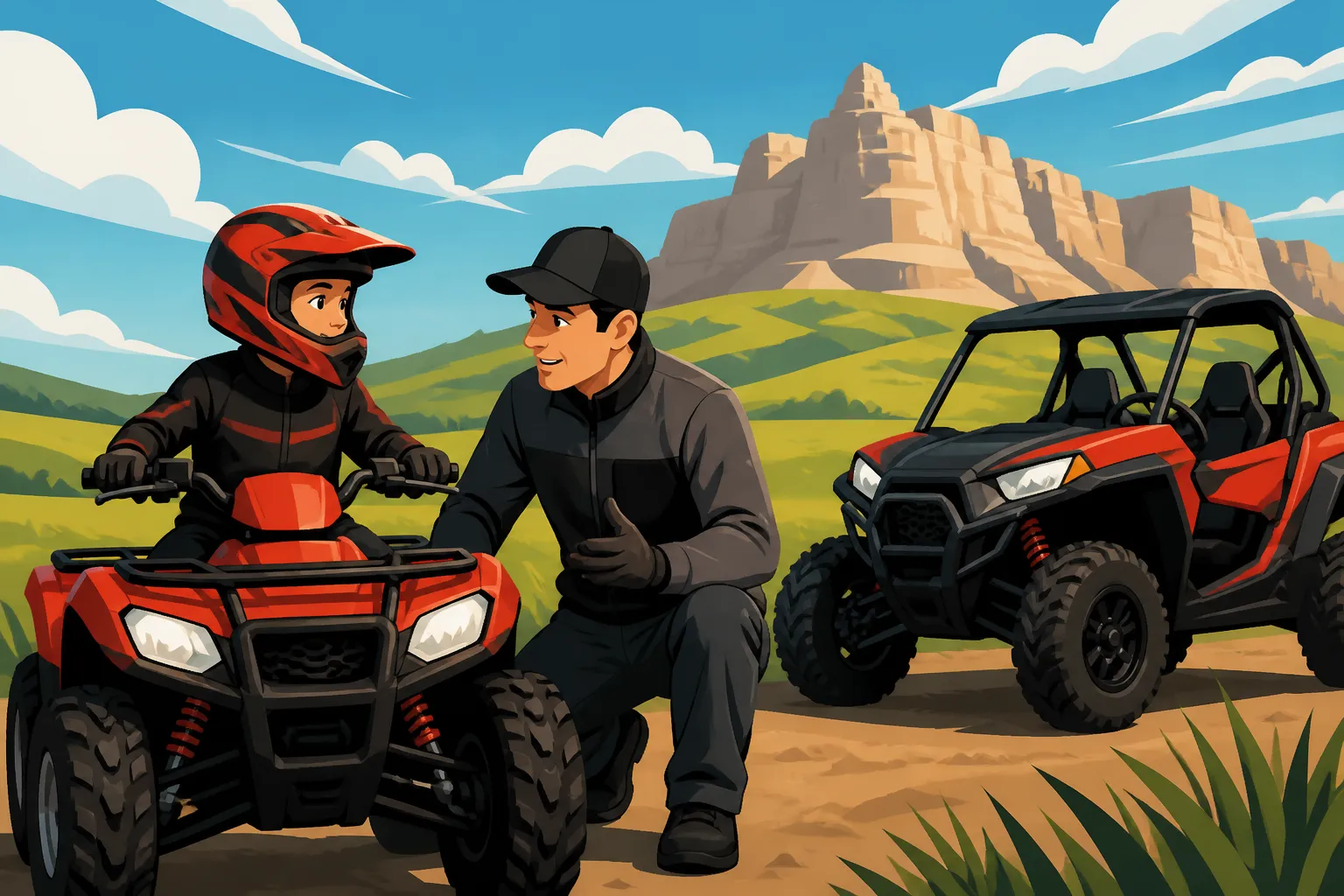
Before starting the engine, explain the controls and agree on a stop signal. The young rider should know where to look, how to stop, what to do if they feel unsure, and that stopping is always acceptable. Make sure the child can repeat the main instructions back to you. If they cannot explain the steps, postpone riding until they can.
A gradual lesson sequence works better than simply riding alongside the child and hoping they learn by watching.
- Walk around the machine together. Point out the controls, brakes, throttle, shutoff, and any restraints. Explain the parts the rider must check before moving.
- Practice mounting and dismounting. Teach the rider to get on and off only when the machine is stopped and secured.
- Practice with the engine off. Let the child sit in position and reach the controls. For a UTV passenger, practice buckling the belt and staying seated.
- Start and stop at walking speed. Demonstrate how to move smoothly, slow down, and stop in a marked area.
- Add simple steering. Use a broad, open space with generous room to turn. Avoid sharp turns and tight obstacles at first.
- Practice stopping on command. Give the rider a clear signal from a safe position and make sure they stop without accelerating or looking away from the route.
- Add one new skill at a time. After basic control is consistent, introduce gentle changes of direction or mild terrain. Do not combine unfamiliar ground, speed, and traffic in the same lesson.
Keep the adult in a position where they can supervise without distracting or crowding the rider. An adult on another machine may not be able to intervene if the child becomes confused or loses control. For beginners, being close enough to give clear instructions from the ground is often more useful than trying to lead the ride from ahead.
Avoid teaching at a pace set by other family members. A child who needs several short lessons to become comfortable with starting, steering, and stopping should get that time. Do not make a public trail ride the reward for merely sitting on the machine or completing one basic loop.
Build a habit of stopping whenever the rider becomes tired, cold, frustrated, or inattentive. A child’s concentration can fade before they say they are tired. Watch for delayed responses, missed instructions, grabbing the throttle, looking away from the route, or trouble holding a steady position. End the lesson before a minor lapse becomes a crash.
A young rider also needs to learn when not to ride. Teach them to stop for an unexpected person, animal, vehicle, hazard, or change in visibility. They should never leave the agreed route or practice area without permission. Make it clear that they must not follow another rider into a closed route or attempt a hill just because someone else did.
Progress should depend on consistent behavior, not on a fixed number of lessons. Before moving to more difficult ground, the rider should be able to control speed, start and stop smoothly, follow directions, keep a safe distance, and remain calm when something changes. If these skills are not dependable in an easy area, a more challenging setting is not the next step.
Gear, Supervision, and Riding on Public Land
Protective gear should be part of every lesson, including low-speed practice. A properly fitted helmet is essential equipment. The helmet should be appropriate for off-road use, fit securely, and be fastened as intended. A helmet that shifts, sits loosely, or blocks the rider’s vision is not a good fit. Check South Dakota Helmet Rules for ATV Riders for the legal requirements, but do not treat the law as a complete safety checklist.
Eye protection matters too. Dust, branches, insects, and small debris can distract or injure a rider. Use suitable goggles or other protective eyewear that stays in place and allows the rider to see clearly. South Dakota’s rules on eye protection are covered in South Dakota Eye Protection Requirement. Consider gloves, long sleeves, long pants, and sturdy over-the-ankle footwear as practical protection against abrasion, weather, and contact with hot or moving parts.
Dress for the conditions and the machine. Loose clothing can catch on controls or equipment. A child should be visible to the supervising adult, especially in a group or in low light. Do not ride in poor visibility simply because the machine has headlights. If the child cannot see the route clearly or you cannot keep track of them, stop.
Supervision means active attention, not just being somewhere nearby. The adult should know the route and rules, stay focused on the young rider, and avoid distractions. Do not supervise while driving a separate machine at a distance, managing a group, or using a phone. If more than one child is riding, arrange enough capable adults to supervise rather than assuming one person can monitor everyone at once.
On public land, the child’s readiness is only one part of the decision. Check the designated route, operating hours, route width, seasonal access, closures, and permit requirements. A trail open to some machines may not be open to a wider UTV. Measure the machine the way the land manager specifies and confirm that its width fits the route. Do not rely only on a map saved before a recent closure or weather event. The South Dakota Trail Closures to Check First and South Dakota Trail Maps and MVUMs provide useful planning context.
For a child, an easy route is not necessarily a safe route. A beginner-friendly trail can still have other riders, steep drop-offs, loose rock, blind corners, dust, or sudden changes in surface. Choose a route that lets the child travel at a comfortable pace without holding up or being pressured by faster traffic. If that is not possible, use an appropriate practice area instead.
Do not assume that a plated machine can use every trail, or that a trail permit allows road use. Plates, permits, and road legality serve different purposes. Check What South Dakota Requires to Plate an ATV if road registration is part of your plan, and confirm the trail permit rules separately. A young rider must also follow any road-use, equipment, and licensing requirements that apply to the machine and route.
A child should never be expected to manage a roadside emergency alone. Make sure they know to stop, remain in a safe place, and wait for the adult if the machine stalls or something goes wrong. Carry a charged phone where service is available, but do not treat coverage as guaranteed, particularly in remote areas. Tell another responsible person where you are going and when you expect to return.
Plan a First Public Ride Carefully
A first public ride should be the result of successful practice, not the place where practice begins. Before leaving home, confirm the child meets the rules for the exact area and can operate the machine in a controlled space. If any part of the trip depends on an exception, a local restriction, or a particular permit, verify it with the responsible land manager or official source.
Use a simple pre-ride check:
- Confirm the machine is appropriate for the child and in sound working order.
- Check age, supervision, route, permit, and equipment rules for the specific riding area.
- Make sure helmets and eye protection fit and are fastened.
- Agree on the route, stop signal, distance between riders, and regrouping points.
- Check weather, trail conditions, and closures shortly before departure.
- Set a modest turnaround point and leave time to return before the child is tired.
- Carry water, basic supplies, and a way to communicate if the group separates.
Explain that the adult sets the pace and may end the ride at any time. A young rider should not be asked to keep up with adults or other children who have more experience. Leave generous space between machines. Dust, sudden braking, and unexpected turns can make a close following distance dangerous, especially for a rider who is still learning.
Keep the first outing short enough that the child can finish while still alert. Choose a familiar route with room to stop and turn around. Avoid a crowded riding day, complicated intersections, steep climbs, and routes where a mistake could carry a rider off a narrow edge. If conditions change, turn around rather than trying to finish the planned loop.
Rental rides need extra checking. A rental operator may set its own age, licensing, supervision, and passenger rules, and those can be stricter than the general rules for riding a privately owned machine. Ask who may operate the vehicle, whether a child may ride as a passenger, what gear is supplied, what routes are allowed, and whether a permit is included. Do not assume a family booking means every child can operate a machine.
A guided ride also does not remove the parent’s responsibility to assess the child. A guide may set the route and explain the controls, but the adult still needs to judge whether the rider can follow instructions and handle the conditions. If the child is anxious, overwhelmed, or unable to keep pace safely, ask to stop or leave the route.
After the ride, talk through what went well and what needs more practice. Keep the discussion specific and calm. Praise sound decisions such as slowing down, stopping when asked, and asking for help. If the rider had difficulty with a skill, return to an easier practice area rather than trying to fix it on a more demanding trail.
For parents, the safest measure of progress is not how far the child rode or how quickly they learned. It is whether they consistently control the machine, follow rules, use protective gear, and make cautious decisions when the ride changes. That standard may mean postponing a public trail ride or choosing a different machine. Those are practical choices, not setbacks.
Frequently Asked Questions
Is there one minimum age for every South Dakota ATV ride?
No single age answers every situation. Rules can differ for private land, public trails, highway right-of-ways, and roads. Age 12 is an important threshold for ditch or right-of-way riding, so verify the current rules and any supervision conditions before planning that type of ride.
Does a child need an ATV safety course in South Dakota?
A safety course is not generally required for every ATV ride, but instruction is still important. Check the rules for the specific land or activity, and consider formal training as a way to build skills even when it is not mandatory.
Can a child ride as a passenger on an ATV?
Only if the machine is designed by its manufacturer to carry a passenger. Most single-rider ATVs are not. A UTV may have designated passenger seats, but occupants should use the restraints and follow the manufacturer’s instructions.
Does an adult’s trail permit cover a child’s machine?
Do not assume it does. Trail permits may be required per machine rather than per rider. Check the rules for the specific riding area and make sure each machine has the required authorization.
Disclaimer
This article is for general informational purposes only and does not constitute professional advice. Laws, prices and regulations vary by location and change over time. Consult a qualified professional for guidance on your specific situation.